
Do You Want to Keep Your Job? Then You Have to be Nice

The Uber driver was being exceptionally nice to me this morning.

“Nice to meet you, sir!” He greeted me cheerily. “I see you want to get to the university. Please, come on in! Can I offer you a bottle of mineral water? Or maybe some pretzels?”

“Thanks.” I said. I looked at the ceiling. No hidden cameras there. “You’re very nice. Very, very nice.”

“Yes, I know.” His face shone in understanding. “But it pays big time. I get good grades from the customers, so Uber’s algorithm is providing me with even more passengers all the time. It just pays to be nice.”

“Oh, so you’re just like those lawyers, physicians and accountants?”

“I don’t know.” He said. “Am I?”

“Absolutely.” I said. “Or rather, soon they’re going to be a lot like you: just plain nice. The thing is, the knowledge industries – and by that I mean professions which require that human beings go over data and develop insights – are undergoing automation. That means artificial intelligence is going to perform a major part of the work in those professions, and then the human workers – the successful ones, at least – will become nice and more polite to their customers.”

“Take Uber for example.” I gestured at the smartphone at the dashboard. “Taxi drivers partly deal with knowledge generation: they receive information from the passenger about the desired destination, and they have to come up with the knowledge of how to get there, based on their memory of the roads. In the past, a mere decade ago, taxi drivers needed to know the streets of the city like the back of their hand.”

“But today we have GPS.” Said my driver.

drive-863123_1280.jpg

“Exactly.” I said. “Today, modern taxi drivers rely on a virtual assistant. It’s not just a GPS that tells you where you are. More advanced apps like Waze and Google Maps also show you how best to reach your destination, with vocal instructions at each step of the way. These virtual assistants allow anyone to be a taxi driver. Even if you never drove in a certain city in the past, you can still do a satisfactory job. In effect, the AI has equalized the playing ground in the field of taxi driving, since it lowered to a minimum the needed skill level. So how can a cabby still distinguish himself and gain an advantage over other drivers?”

“He has to be nice.” Smiled the guy at the wheel. I wondered to myself if he ever stops smiling.

“That’s what we see today.” I agreed. “The passengers are rating every driver according to the experience they had in his cab, since that is the main criteria left when all the others are equal. And Uber is helping the process of selecting for niceness, since they stop working with drivers who aren’t nice enough.”

“But what does it have to do with lawyers, accountants and physicians?” Asked the driver.

“We’re beginning to see a similar process in other knowledge-based professions.” I explained. “For example, just last week a new AI engine made the news: it’s starting to work in a big law firm, as a consultant to lawyers. And no wonder: this AI can read and understand plain English. When asked legal questions, the AI conducts research by going over hundreds of thousands of legal papers and precedents in seconds, and produces a final answers report with detailed explanations about how it has reached each answer. It even learns from experience, so that the more you work with it – the better it becomes.”

“So we won’t even need lawyers in the future?” Finally, the guy’s smile became genuine.

“Well, we may reach that point in the end, but it’ll take quite some time for us to get there.” I said. “And until that time, we’ll see AI engines that will provide free legal consultation online. This kind of a free consultation will suffice for some simple cases, but in the more sophisticated cases people will still want a living lawyer in the flesh, who’ll explain to them how they should act and will represent them in court. But how will people select their lawyers out of the nearly-infinite number of law school graduates out there?”

“According to their skill level.” Suggested the driver.’

“Well, that’s the thing. Everyone’s skills will be near equal. It won’t even matter if the lawyers have a big firm behind them. The size of the firm used to matter because it meant the top lawyers could employ tens of interns to browse through precedents for them. But pretty soon, AI will be able to do that as well. So when all lawyers – or at least most – are equal in skills and performance, the most employed lawyers will be the nice ones. They will be those who treat the customer in the best way possible: they will greet their clients with a smile, offer them a cup of tea when they set for in the office, and will have great conversational skills with which to explain to the client what’s going on in court.”

“And the same will happen with accountants and physicians?” He asked.
doctor-1193318_640.jpg

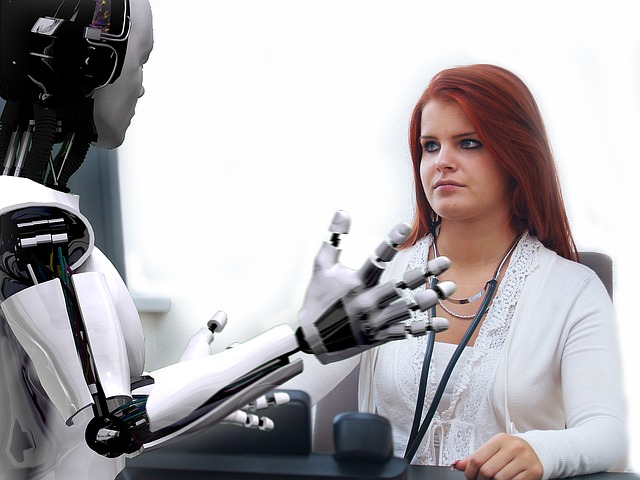
“It’s happening right now.” I said. “The work of accountants is becoming easier than ever before because of automation, and so accountants must be nicer than ever before. Soon, we’ll see the same phenomenon in the medical professions as well. When AI can equalize the knowledge level of most physicians, they will be selected according to the way they treat their patients. The patients will flock to the nicer physicians. In fact, the professionals treating the patients won’t even have to have a deep understanding in the field of medicine, just as today’s cabbies don’t need to fully remember the roads in the city. Instead, the medical professionals will have to understand people. They will need to relate to their patients, to figure them out, to find out what’s really bothering them, and to consult with the AI in order to come up with the insights they need in order to solve the patients’ issues.”

“So we gotta keep the niceness on.” Summarized my driver, as he parked the car in front of the entrance to the mall. “And provide the best customer service possible.”

“That’s my best advice right now about work in the future.” I agreed. I opened the door and started getting out of the car, and then hesitated. I turned on my smartphone. “I’m giving you five stars for the ride. Can you give me five too?”

His gaze lingered on me for a long time.

“Sorry.” He finally said. “You talk too much, and really – that’s not very nice.”

 

Do You Want to Understand the future? World of Warcraft Holds the Answers

Players of World of Warcraft love to complain. There’s nothing new to that. Blizzard largely seems to ignore the players’ pleas, yells and moans, and yet recently one of the executives has decided to answer the community. In a response to a forum thread, assistant game director Ion Hazzikostas explained how World of Warcraft is actually working right now. His response tells us a lot about the inner works of a world of abundance – where everyone have their basic needs fulfilled.


Catering to Minorities

The first thing we need to understand, according to Hazzikostas, is that World of Warcraft is composed of many minority groups. As he says –

“A minority of players raid. A minority of players participate in PvP. A tiny minority touch Mythic raiding. A tiny minority of players do rated PvP. A minority of players have several max-level alts. A minority of players do pet battles, roleplay, list things for sale on the auction house, do Challenge Mode dungeons, and the list goes on.”

The result is that Blizzard – the omnipotent lord and god of World of Warcraft – is catering to minorities. In fact –

“…almost every facet of WoW is an activity that caters to a minority of the playerbase.”

This is what happens when you have a world of abundance. When people know that all of their basic needs will be taken care of, they feel free to do whatever they like. A minority will create art. A minority will sail boats. A minority will focus on re-engineering their bodies, roleplay or do robot battles.

And the government will need to cater to all of these minorities.

ss_2B_2016-04-10_2Bat_2B09.42.32_.0.0.jpg
World of Warcraft: a future of minorities. Credit: Polygon

The Self-Focused Minorities

Another point made by Hazzikostas is that the minorities are extremely self-focused. As he puts it –

“…due to the cooperative nature of the game, players tend to make connections with others who favor a similar playstyle. I’m generalizing a bit here, and there are certainly exceptions, but I’d guess that a typical Gladiator-level player probably doesn’t have a WoW social group that consists of people who mostly solo-level alts and explore the world. And most small friends-and-family guilds don’t spend a lot of time talking to competitive Mythic raiders. So when there’s a change, or a feature, that is aimed at a portion of the game that isn’t your personal playstyle, it’s easy and in fact natural to have the sense that “everyone” dislikes it.”

Hazzikostas is essentially talking about group polarization – a phenomenon that occurs in groups in which people agree with each other. Their views resonate between each other, and the group member become more polarized in their opinions. In a way, they become detached from the complex reality of each situation, and become unable to consider things from other points of view.

Group polarization is happening in the real world too, and it’s gaining speed. Ezra Klein recently wrote about political polarization and how it’s becoming an issue in the United States. People are becoming more polarized in their political views, and part of it has to do with the virtual world. In the past, you would’ve needed to interact with people from other factions everywhere you went. Today, Facebook automatically makes sure via its algorithms that most of your interactions are with the people who think the same as you do. As a result, people are essentially segregating themselves willingly into self-selecting groups, and their views become more polarized, so that each group finds it more difficult to agree with the other groups than ever before.

World-of-warcraft-8.jpg
World of Warcraft: a future of group and minority polarization

A Mirror for the Future

In those two aspects at least, World of Warcraft is a mirror of our future. As we reach a state of abundance in food and shelter, we will start identifying ourselves according to our hobbies and our interests. A world of abundance would therefore also be a world of minorities. And due to the virtual nature of much of that world, those minorities would find it more difficult to agree with each other than ever before.

It just might be the in the long-term, the only viable solution would be to essentially create a different world for every kind of minority. This proposition is, of course, impossible in the physical world where resources are limited by their nature. It can be achieved, though, in the interaction between the physical and the virtual worlds.

In the case of World of Warcraft, the virtual environment ensures that funds are essentially unlimited. Blizzard sets the challenges and the rewards, which are virtual in nature. Luckily for us, many aspects of our lives in the future are going to be virtual as well. As virtual reality (VR) and augmented reality (AR) become part of our lives, we will receive highly personalized and individualized information from physical reality. In many cases, the virtual layer of reality will allow us to transcend the physical bottom layer.

To understand that, consider that in twenty years at most, many of us are likely to walk around with augmented reality goggles over our eyes. These will provide an additional virtual layer over everything that we see. In that way, a signpost on the street can consist of just a white background and a QR code in the physical world. The AR goggles, however, will translate the QR code into a personal ad that will fit specifically for the individual using the goggles. Similarly, every house can be virtually transformed into a palace, by wearing an AR device. A palace, or a cave, or a torture dungeon, or a boat. To each minority – their own.


Conclusions

World of Warcraft is a virtual world, in which players enjoy a state of abundance. In a way, it serves as a social or political studies lab, and the insights we gain from it can be valuable. Those insights can help us better understand the future of a world of abundance, and of a world in which the virtual and the physical layers become intermixed. If you want to know what the future holds in store for us – you probably want to keep on watching how World of Warcraft evolves.


The Flying Taxis Are On Their Way

A while ago I’ve written in this blog about flying cars, and how we should start seeing them in our sky en masse towards 2035. It’s always nice to check on such forecasts and see how they’re progressing along and are reinforced by recent events. So here’s an update, composed of two recent news from April: one of them is basically an eye candy, while the other could be a serious indicator that flying cars are afoot (pun fully intended).


The Eye Candy

Let’s open with the pretty and shiny stuff. It turns out an aerial innovator has just flown his own invention, the Flyboard Air, a whooping distance of 2,252 meters. He basically smashed through the old record of 275 meters, going at a height of 30 meters above water, at a top speed of around 70 km/h. That’s an impressive achievement!
https://youtu.be/NOGzIt0T5GU

Unfortunately, it doesn’t mean anything for a future of flying cars.

The main reason for my lack of enthusiasm is that the hoverboard is powered by jet fuel – A1 kerosene carried on the user’s back. As long as flying cars are powered by conventional fossil fuels, they won’t find their way into common use. Flying simply takes too much energy, and fossil fuels are too expensive and harmful to the environment to be used to power such wasteful activity. The only flying cars that have a chance to succeed are ones that operate on electricity, and that’s only if we assume that electricity is about to become abundant due to the exponential rise in solar energy use.

So this is probably just another pretty invention, but when such inventions appear on the market one after the other, one starts to see a trend. You can’t ignore the fact that aerial drones capable of carrying a human passenger begin to appear more and more on the news. Will all these innovations lead to an actual flying taxi service? Only if the two conditions I specified in the original post about flying cars come true: they need to be electric, and they need to be autonomous so that you don’t have an expensive (and prone to mistakes) human pilot.


The Flying Taxis of the Future

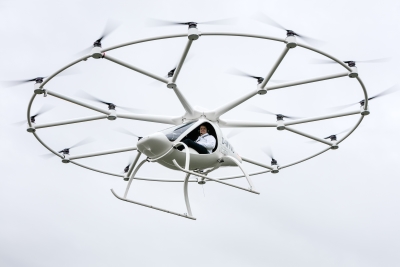
In the last two months, exciting things have happened for e-volo: the manufacturer of the world’s first certified Multicopter (i.e. a helicopter with multiple rotors).

amp.enews.airtaxia.jpg
First manned flight with Alexander Zosel. Source: ASM International

The Multicopter has received a permit to fly from the German authorities in February 2016. The certified Multicopter’s first manned flight took place at the end of March, and ended with absolutely no issues. The pilot controlled the vehicle easily with a single joystick, and the Multicopter was stable and autonomous enough to retain its position automatically even when the pilot released his hand from the joystick.
https://www.youtube.com/watch?v=XGbcpIIhZjs
 

The vehicle can reach a speed of up to 100 km/h, with 18 rotors powered by nine independent batteries, and a 450 kg take-off weight. The large number of rotors and batteries means that even if one of them fails, the Multicopter can still stay high in the air. Since the Multicopter relies on electric motors, it is one of the top candidates in the race to become the world’s first air taxi.

Which is exactly what e-volo, the company behind the Multicopter, is trying to do.

According to ASM International, e-volo is looking to create a new market of air taxi services. In the short term, they plan to use the personal vehicles on certain predetermined routes, where there will be no chance for collision. In the medium term, however, they are already thinking about providing the vehicles with autonomous capabilities, so that they will be able to go any way the passenger chooses. The passenger will pick the destination, and the AI will make sure that the air taxi brings him there safely.


Conclusions

There are encouraging indicators that air taxi services will indeed become reality by 2035, but the obstacles are still out there. We still need to develop more reliable personal aircrafts with improved autonomous functions. Also, electric flying vehicles will still require an abundance of energy for mass-scale use, and such energy will have to come from an abundant source: the Sun. That means we’ll have to keep an eye for developments in solar energy harvesting as well. Luckily, solar energy is moving forward at an exponential rate.

So, if everything comes together just right, I still stand by my original forecast: flying taxis by 2035 it is!

Futuronymity: Keeping Our Privacy from Our Grandchildren

History is a story that will never be told fully. So much of the information is lost to the past. So much – almost all – the information is gone, or has never been recorded. We can barely make sense of the present, in which information about the events and the people behind them keeps being released every day. What chance do we have, then, at fully deciphering the complex stories underlying history – the betrayals, the upheavals, the personal stories of the individuals who shaped events?

The answer has to be that we have no way of reaching any certainty about the stories we tell ourselves about our past.

But we do make some efforts.

Medical doctors and historians are trying to make sense of biographies and ancient skeletons, in order to retro-diagnose ancient kings and queens. Occasionally they identify diseases and disorders that were unknown and misunderstood at the time those individuals actually lived. Mummies of ancient pharaohs are x-rayed, and we suddenly have a better understanding of a story that unfolded more than two thousand years ago and realize that the pharaoh Ramesses II suffered from a degenerative spinal condition.

Similarly, geneticists and microbiologists use DNA evidence to end mysteries and find conclusive endings to some historical stories. DNA evidence from bones has allowed us to put to rest the rumors, for example, that the two children of Czar Nicholas II survived the 1918 revolution in Russia.

Russian_Imperial_Family_1911
The Russian czar Nicholas II with his family. DNA evidence now shows conclusively that Anastasia, the youngest daughter, did not survive the mass execution of the family in 1918. Source: Wikipedia

The above examples have something in common: they all require hard work by human experts. The experts need to pore over ancient histories, analyze the data and the evidence, and at the same time have good understanding of the science and medicine of the present.

What happens, though, when we let a computer perform similar analyses in an automatic fashion? How many stories about the past could we resolve then?

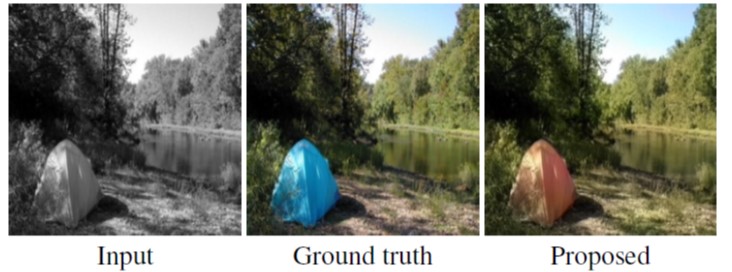
We are rapidly making progress towards such achievements. Recently, three authors from Waseda University in Japan have published a new paper showing they can use a computer to colorize old black & white photos. They rely on convolutional neural networks, which are in effect a simulation of certain structures of a biological brain. Convolutional neural networks have a strong capacity for learning, and can thus be trained to perform certain cognitive tasks – like adding color to old photos. While computerized coloring has been developed and used before, the authors’ methodology seems to achieve better results than others before them, with 92.6 percent of the colored images looking natural to users.

Colorized pictures from the past
Colorized black & white pictures from the past. AI engine was used to add color – essentially new information – to these hints from our past. Source: paper by Iizuka, Simo-Serra and Ishikawa

This is essentially an expert system, an AI engine operating in a way similar to that of the human brain. It studies thousands of thousands of pictures, and then applies its insights to new pictures. Moreover, the system can now go autonomously over every picture ever taken, and add a new layer of information to it.

There are boundaries to the method, of course. Even the best AI engine can miss its mark in cases where the existing information is not sufficient to produce a reliable insight. In the examples below you can see that the AI colored the tent orange rather than blue, since it had no way of knowing what color it was originally.

But will that stay the case forever?

Colorized black & white picture - with wrong color
Colorized black & white picture that was colored incorrectly since no information existed about the tent from other sources. Source: paper by Iizuka, Simo-Serra and Ishikawa

As I previously discussed in the Failures of Foresight series of posts on this blog, the Failure of Segregation is making it difficult for us to forecast the future because we’re trying to look at each trend and each piece of evidence on its own. Let’s try to work past that failure, and instead consider what happens when an AI expert coloring system is combined with an AI system that recognizes items like tents and associates them with certain brands, and can even analyze how many tents of each color of that brand were sold on every year – or at least what was the most favorite tent color for people at that time.

When you combine all of those AI engines together, you get a machine that can tell you a highly nuanced story about the past. Much of it is guesswork, obviously, but those are quite educated guesses.


The Artificial Exploration of the Past

In the near future, we’ll use many different kinds of AI expert systems to explore the stories of the past. Some artificial historians will discover cycles in history – princes assassinating their kingly fathers, for example – that have a higher probability to occur, and will analyze ancient stories accordingly. Other artificial historians will compare genealogies, while yet others will analyze ancient scriptures and identify different patterns of writing. In fact, such an algorithm had already been applied to the Bible, revealing that the Torah has been written by several different authors and distinguishing between them.

The artificial exploration of the past is going to add many fascinating details to stories which we’ve long thought were settled and concluded. But it also raises an important question: when our children and children’s children look back at our present and try to derive meaning from it – what will they find out? How complete will their stories of their past and our present be?

I suspect the stories – the actual knowledge and understanding of the order between events – will be even more complete than what we who dwell in the present know about.


Past-Future

In the not-so-far-away future, machines will be used to analyze all of the world’s data from the early 21st century. This is a massive amount of data: 2.5 quintillion bytes of data are created daily, which would fill ten million blu-ray discs altogether. It is astounding to realize that 90 percent of the world’s data today has been created just in the last two years. Human researchers would not be able to make much sense of it, but advanced AI algorithms – a super-intelligence, in some ways – could actually have the tools to crosslink many different pieces of information together to obtain the story of the present: to find out what movies families had watched on a specific day, in which hotel the President of the United States stayed during a recent visit to France and what snacks he ordered on room service, and many other paraphernalia.

Are those details useless? They may seem so to our limited human comprehension, but they will form the basis for the AI engines to better understand the past, and produce better stories of it. When the people of the future will try to understand how World War 3 broke out, their AI historians may actually conclude that it all began with a presidential case of indigestion which happened at a certain French hotel, and which annoyed the American president so much that it had prevented him from making the most rational choices in the next couple of days. An hypothetical scenario, obviously.


Futuronymity – Maintaining Our Privacy from the Future

We are gaining improved tools to explore the past with, and to derive insights and new knowledge even where information is missing. These tools will be improved further in the future, and will be used to analyze our current times – the early 21st century – as well.

What does it mean for you and me?

Most importantly, we should realize that almost every action you take in the virtual world will be scrutinized by your children’s children, probably after your death. Your actions in the virtual world are recorded all the time, and if the documentation survives into the future, then the next generations are going to know all about your browsing habits in the middle of the night. Yes, even though you turned incognito mode on.

This means we need to develop a new concept for privacy: futuronymity (derived from Future and Anonymity) which will obscure our lives from the eyes of future generations. Politicians are always concerned about this kind of privacy, since they know their critical decisions will be considered and analyzed by historians. In the future, common people will find themselves under similar scrutiny by their progenies. If our current hobby is going to psychologists to understand just how our parents ruined us, then the hobby of our grandchildren will be to go to the computer to find out the same.

Do we even have the right to futuronymity? Should we hide from next generations the truth about how their future was formed, and who was responsible?

That question is no longer in the hands of individuals. In the past, private people could’ve just incinerated their hard drives with all the information on them. Today, most of the information is in the hands of corporations and governments. If we want them to dispose of it – if we want any say in which parts they’ll preserve and which will be deleted – we should speak up now.


The Activated World: from Solar Power to Food


Solar panels are undergoing rapid evolution in the last ten years. I’ve written about this in previous posts in the blog (see for example the forecast that we’ll have flying cars by 2035, which is largely dependent on the sun providing us with an abundance of electricity). The graph below is pretty much saying it all: the cost for producing just one watt of solar energy has gone down to somewhere between 1 percent and 0.5 percent of what it used to be just forty years ago.

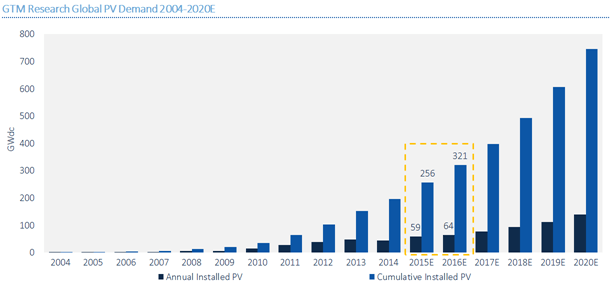
At the same time that prices go down, we see more installations of solar panels worldwide, roughly doubling every 2-3 years. Worldwide solar capacity in 2014 has been 53 times higher than in 2005, and global solar photovoltaic installations grew 34% in 2015 according to GTM Research.

gtm-global_install.png
Source: GTM Research

It should come as no surprise that regulators are beginning to take note of the solar trend. Indeed, two small California cities – Lancastar and Sebastopol – passed laws in 2013 requiring new houses to include solar panels on their roofs. And now, finally, San Francisco joins the fray as the first large city in the world to require solar panels on every new building.

San Francisco has a lofty goal: meeting all of its energy demands by 2025, using renewable sources only. The new law seems to be one more step towards that achievement. But more than that, the law is part of a larger principle, which encompasses the Internet of Things as well: the Activation of Everything.


The Activation of Everything

To understand the concept of the Activation of Everything, we need to consider another promising legislation that will be introduced soon in San Francisco by Supervisor Scott Wiener. Supervisor Wiener is allowing solar roofs to be replaced with living roofs – roofs that are covered with soil and vegetation. According to a 2005 study, living roofs reduce cooling loads by 50-90 percent, and reduce stormwater waste and runoff to the sewage. They retain much of the rainwater, which later goes back to the atmosphere through evaporation. They enhance biodiversity, sequester carbon and even capture pollution. Of course, not every plant can be grown efficiently on such roofs – particularly not in dry California – but there’s little doubt that optimized living roofs can contribute to the city’s environment.

Supervisor Wiener explains the reasons behind the solar power legislation in the following words –

“This legislation will activate our roofs, which are an under-utilized urban resource, to make our City more sustainable and our air cleaner. In a dense, urban environment, we need to be smart and efficient about how we maximize the use of our space to achieve goals like promoting renewable energy and improving our environment.”

Pay attention to the “activate our roofs” part. Supervisor Wiener is absolutely right in that the roofs are an under-utilized urban resource. Whether you want to use those roofs to harvest solar power or to grow plants and improve the environment, the idea is clear. We need to activate – in any means possible – our resources, so that we maximize their use.

Green_City.jpg
A living roof in lower Manhattan. Source: Alyson Hurt, Flickr

That is what the Activation of Everything principle means: activate everything, whether by allowing surfaces and items to harvest power or resources, or to have sensing and communication capabilities. In a way, activation can also mean convergence: take two functions or services that were performed separately in the past, and allow them to be performed together. In that way, a roof is no longer just a means to provide shade and protection from the weather, but can also harvest energy and improve the environment.

The Internet of Things is a spectacular example for implementing the Activation of Everything principle. In the Internet of Things world, everything will be connected: every roof, every wall, every bridge and shirt and shoe. Every item will be activated to have added purposes. Our shirts will communicate our respiration rate to our physicians. Bricks in walls will report on their structural integrity to engineers. Bridges will let us know that they’re close to maximum capacity, and so on.

The Internet of Things largely relies on sophisticated electronic technologies, but the Activation of Everything principle is more general than that. The Activation of Everything can also mean creating solar or living roofs, or even creating walls that include limestone-secreting bacteria that can fix cracks as soon as they form.

Where else can we implement the Activation of Everything principle in the future?


The Activation of Cars

There have been many ideas to create roads that can harvest energy from cars’ movements. Unfortunately, the Laws of Thermodynamics reveal that such roads will in fact ‘steal’ that energy from passing cars, by making it more difficult for them to travel along the road. Not a good idea. The activation of roofs works well specifically because it has a good ROI (Return on Investment), with a relatively low energetic investment and large returns. Not so with energy-stealing roads.

But there’s another unutilized resource in cars – the roof. We can use the Activation principle to derive insights about the future of car roofs: hybrid cars will be covered with solar panels, which will be used to harvest energy when they’re sitting in the parking lot, and store it for the ride home.

Don’t get the math wrong: cars with solar roofs won’t be able to drive endlessly. In fact, if they rely only on solar power, they’ll barely even crawl. However, they will be able to power the electrical devices in the car, and trucks may even use solar energy on long journeys, to cool the wares they carry. If the cost of solar panel installation continues to go down, these uses could be viable within the decade.


The Activation of Farmlands

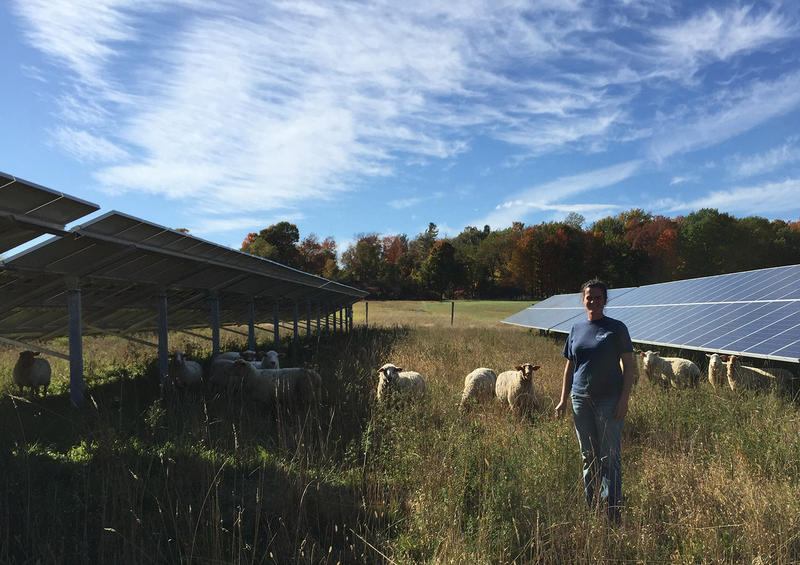
Farmlands are being activated today in many different ways: from sensors all over the field, and sometimes in every tree trunk, to farmers supplementing their livelihood by deploying solar panels and ‘farming electricity’. Some are combining both solar panels and crop and animal farming by spreading solar panels at a few meters height above the field, and growing plants that can make the most of the limited sunlight that gets to them.


Anna-Freund-open-view-farm-vpr-bodette-201510
Anna Freund run the Open View Farm. Source: VPR

The Activation of the Air

Even the air around us can be activated. Aerial drones may be considered an initial attempt to activate the sky by filling them with flying sensors, but they are large, cumbersome and interfere with aerial traffic and with the view. However, we’ll be able to activate air in various other ways in the future, such as smart dust – extremely small sensors with limited wireless connectivity that will transmit data about their whereabouts and the conditions there.


The Activation of Food

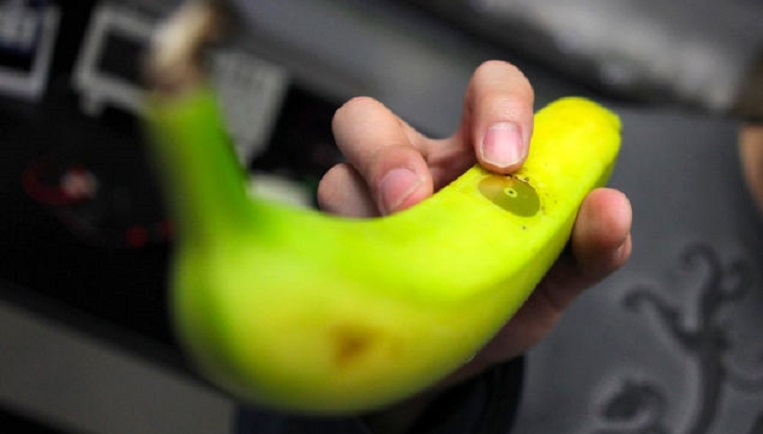
Food is one of the only things that have barely been activated so far. Food today serves only two goals: to please by tasting great, and to nourish the body. According to the principle of Activation, however, food will soon serve several other purposes. Food items could be used to deliver therapeutics or sensors into the body, or possibly be produced with built-in biocompatible electronics and LEDs to make the food look better on the plate.

WIMF_sensor
Activated food: a banana with an edible food sensor, developed by researchers at Tufts University. Source: factcoexist.com

Conclusions

As human beings, we’ve always searched for ways to optimize efficiency and to make the best use of the limited resources we have. One of those limited resources is space, which is why we try to activate – add functions – to every surface and item today.

It’s fascinating to consider how the Activation of Everything will shape our world in the next few decades. We will have sensors everywhere, solar panels everywhere, batteries and electronics everywhere. It will be a world where nothing is as it seems at first glance anymore. An activated world – a living world indeed.


Rejecting Nature – and Breastfeeding

Far away into the future, when people look back at the 20th century, they’ll say that it was the century when mankind has truly begun rejecting Nature.

What is “Nature”? That term, which some of us regard so highly today, is simply the current products of an ongoing evolutionary process – just the same as us. Human beings are a similar product of an evolutionary process which has left us with physical, hormonal and mental characteristics that have served us well in the prehistorical past, but are far from beneficial in our present society.

The most impressive way in which we’ve rejected Nature in the 20th century is probably with the invention and proliferation of use of birth control measures.

The 20th century has seen women reject Nature with the establishment of the first permanent birth-control clinic in 1921, where women were taught how to use a cervical cap, in a time when distribution of birth control information was illegal by law in the United States. In 1957, the FDA approved the first contraceptive pill to be taken orally, but only “for severe menstrual disorders,” which has led to an unusually large number of women suddenly reporting severe menstrual disorders. Those women were desperate to escape the decrees of Nature which have been enforced on their bodies without their willingness or consent. Just how much do they want that? According to a series of 2012 surveys in developing countries, the number of women who want to avoid pregnancy has reached 867 million out of 1520 million, or 57%. Many of those women want to promote their careers or expand their education before having a child. In short, they want to fulfill their potential as human beings instead of plodding blindly along the path evolution has set for them. They want to choose for themselves.

360_clinic_0503.jpg
The first birth control clinic in the United States. Source: Everett Collection, as posted in Time

Society, of course, has been trying to hold them back in the meantime. While it is no longer illegal to use contraceptives, the clergy is still speaking harshly against such practices. Even the currently reigning Pope Francis has not authorized the use of contraceptives, and Pope Pius XII explained in 1951 that the teaching against contraceptives –

“is in full force today, as it was in the past, and so will be in the future also, and always, because it is not a simple human whim, but the expression of a natural and divine law


Natural Breastfeeding?

Society keeps on holding people to the standards of that ‘natural and divine law’, even if those human beings aren’t catholic. Breastfeeding, for example, has been promoted in recent decades as contributing to the baby’s health, wellbeing and development. Now new evidence begins to appear that contradicts some of these claims. Specifically, it seems studies from the last 25 years that have compared between breastfed babies and non-breastfed ones, have not ruled out some important economic, social and cultural confounding factors. When those factors are taken into account, it turns out that breastfeeding is marginally better, at best, for babies.

Does that mean women shouldn’t breastfeed? Of course not. There are plenty of studies out there showing that breastfeeding has benefits for mothers as well as for babies. But we shouldn’t forget that it has its share of issues as well: for many it’s a painful, stressful and time-consuming exercise, making it difficult for women to continue advancing their careers, education and yes, their sex lives too. This is a noble sacrifice many mothers make – but what if it’s not needed after all? What if our technology has already improved formulas enough to replace breastfeeding with no damage to babies?

I fear that even in that case, many people will remain convinced that “breast is best”. Why? They will say that it’s natural, that it’s just the way Nature designed us. And they won’t consider that just a hundred years ago, it was deemed unnatural and illegal for women to use contraceptives, and that two hundred years ago life-saving vaccines were considered unnatural too.

maryjesussm.jpg
“Breast is Best” ad by PETA

This all means that we need to be more suspicious towards arguments that advocate for the ‘natural means’. The scientific evidence for ‘breast is best’ for babies seems to have been shaky right from the outset, and I suspect that had it not resonated so well with our natural fallacy and bias, the scientific and medical establishment would not have accepted them as easily.


Conclusions

There is a widespread perception that Nature is an infallible and benevolent mistress. Nothing could be further from the truth. In fact, Nature is that semi-random evolutionary process which has shaped us in ways that would’ve been beneficial (occasionally) ten-thousand years ago, but which now come into conflict with our modern values and ways of life. Every aspect of our biology and psych that is considered ‘natural’ should (and will) be scrutinized carefully in the 21st century, and if it does not fit our modern values – it should be reconsidered.

Does that mean we should tell women not to give birth to children, or to avoid breastfeeding them? Of course not. We should, however, give them the choice over their bodies.

Even though, you know, that sort of thinking would’ve been considered unnatural a hundred years ago.


The New Age of Conspiracies

Last week, the most famous monster in the world has finally been discovered: Nessie, the Loch Ness monster, has been found. It is nine meters long, with a long and truly monstrous neck. The abomination currently resides some 200 meters below the surface of the water, where it is waiting for no one in particular. Because, you see, it’s a film prop.

The prop was built for a Sherlock Holmes movie back in 1969, and unfortunately sunk below the surface and never came back up. It has now been discovered by an underwater drone equipped with sonar imaging, operated by Norwegian company Kongsberg Maritime.

_89210697_nessiefive.jpg
Nessie, underwater. Source: Kongsberg Maritime

This is an amusing story, of course, but it holds tantalizing hints to the future of conspiracies in a world that is rapidly becoming transparent. In a not-so-distant future, we are going to have drones and satellites mapping out every piece of land on Earth, whether it be at the North Pole, in the deepest Amazonian jungles, or on the bottom of the ocean. We are going to be better acquainted with the Earth than ever before.

Robotic drones will not be the only ones to watch over the Earth. We will take part in that venture, too.

In the past, if you would’ve observed a UFO in the sky, or an Abominable Snowman with big feet, or a vampire draining its victim’s blood, you would’ve needed to run away swiftly to get your bulky camera and obtain a proof for the thing you saw. Today, everyone has a smartphone with a high-quality camera in their pockets. Citizens document police brutality, gang wars, and random acts of kindness using these devices. And yet, despite the fact that suddenly everyone can record anything they see, no reliable evidence for the existence of UFOs, yetis or (living) Loch Ness monsters has come up.

The lack of evidence, in an age when everything becomes known, does not seem to bother the general public. A 2012 survey revealed that 36 percent of the American population believe that UFOs are real, which is approximately the same number as uncovered in a Canadian 2008 survey. This is hardly surprising: we’ve only had smartphones for nine years now, and society has not yet reshaped its myths around the idea that anything that happens in the corporeal world is bound to be recorded and analyzed.

In the long term, however, cryptozoology – the search for mythical creatures – will become obsolete and subject to ridicule, even more than it is today.

But conspiracy theories will live on. In fact, they may even become more powerful than they currently are.


The Future of Conspiracies

Conspiracy theories have no formal definition accepted by all, but for the purpose of this post we can accept Sunstein and Vermeule’s definition that they are –

“…an effort to explain some event or practice by reference to the machinations of powerful people, who have also managed to conceal their role.”

Conspiracies are often used by human beings to explain why bad things happen. We are, after all, rational animals, and we look for reasons for everything that happens around us. We search for patterns and for stories that fit those patterns. For example, we have a tendency towards proportionality bias – our automatic belief that big events, like the JFK assassination, must be related to big causes and can’t be the result of a work of a single madman.

Conspiracy theorists also rely on cherry picking – taking a large volume of information and picking out of it the pieces which support a certain pattern while ignoring the rest.

In the future, we will have an abundance of data. However, data does not lead automatically to insights, knowledge and understanding. These rely on careful analysis of the data, usually performed by experts who understand how to suggest and falsify hypotheses and how to differentiate between authentic readings and noise. The plethora in data, therefore, will lead to plenty of ‘evidence’ which conspiracy theorists will use to support their ideas.


Why Should You Be Concerned?

Why should this development concern you? Because conspiracy theories can proliferate rapidly in the online world and on social networks. If you’re a business or a government agency that releases data to the public, you should be aware that some conspiracy theorists will mine that data someday. When they do – they will find some correlations there that they could use to support their ideas. And when they find those and post them online, you can expect twitstorm, a Facebook massively shared post, or a viral Youtube clip – all of which will severely damage the reputation of your organization.

To counter that threat, businesses and government agencies should start developing a new role: an anti-conspiracy officer. It is not enough to rely on the new-media experts to calm a twitstorm – they know how to use the medium, but they don’t have the necessary understanding of the content. Anti-conspiracy officers will need to work together with the new-media experts to counter new conspiracy theories by providing correct analyses of the existing data, and presenting them in a way that everyone can understand.

Today, we have public intellectuals – calling themselves Skeptics – as such anti-conspiracy officers acting on behalf of the public. These include Steven Novella, Neil deGrasse Tyson, PZ Myers, and many others. As far as I’m aware, they do not receive compensation for companies or from governments for their time and effort handling conspiracy theories on social networks in real-time.

Maybe it’s time to start funding these skeptical exercises in a more organized way.

Skeptic+Trumps+Flyer
The Skeptic Trumps. Source: The Reason Stick

Conclusions

We gain better and more powerful tools to record and document everything that’s going on in the world, but most of humanity still does not have the necessary thinking tools and methods to derive valuable and truthful insights out of the collected data. Conspiracies will likely thrive in this environment, but we can hinder their proliferation and growth on the internet by educating the public.

Don’t Tell Me Not To Make Love with My Robot

Pepper is one of the most sophisticated household robots in existence today. It has a body shape that reminds one of a prepubescent child, only reaching a height of 120 centimeters, and with a tablet on its chest. It constantly analyzes its owner’s emotions according to their speech, facial expressions and gestures, and responds accordingly. It also learns – for example, by analyzing which modes of behavior it can enact in order to make its owner feel better. It can even use its hands to hug people.

pepper-robot-sale
Pepper the Robot. Source: The Monitor Daily.

No wonder that when the first 1,000 Pepper units were offered for sale in Japan for $1,600, they were all sold in one minute. Pepper is now the most famous household robot in the world.

Pepper is probably also the only robot you’re not allowed to have sex with.

According to the contract, written in Japanese legal speak and translated to English, users are not allowed to perform –

“(4) Acts for the purpose of sexual or indecent behavior, or for the purpose of associating with unacquainted persons of the opposite sex.”

What does this development mean? Here is the summary, in just three short points.


First Point: Is Pepper Being Used for Surveillance?

First, one has to wonder just how SoftBank, the robot’s distributors in Japan, is going to keep tabs on whether the robot has been sexually used or not. Since Pepper’s price includes a $200 monthly “data and insurance fee”, it’s a safe bet that every Pepper unit is transmitting some of its data back to SoftBank’s servers. That’s not necessarily a bad thing: as I’ve written in Four Robot Myths it’s Time We Let Go of, robots can no longer be seen as individual units. Instead, they are a form of a hive brain, relying on each other’s experience and insights to guide their behavior. In order to do that, they must be connected to the cloud.

This is obviously a form of surveillance. Pepper is sophisticated enough to analyze its owner’s emotions and responses, and can thus deliver a plethora of information to SoftBank, advertisers and even government authorities. The owners could probably activate a privacy mode (if there’s not a privacy mode now, it will almost certainly be added in the near future by common demand), but the rest of the time their behavior will be under close scrutiny. Not necessarily because SoftBank is actually interested in what you’re doing in your houses, but simply because it wants to improve the robots.

And, well, also because it may not want you to have sex with them.

This is where things get bizarre. It is almost certainly the case that if SoftBank wished to, it could set up a sex alarm to blare up autonomously if Pepper is repeatedly exposed to sexual acts. There doesn’t even have to be a human in the loop – just train the AI engine behind Pepper on a large enough number of porn and erotic movies, and pretty soon the robot will be able to tell by itself just what the owner is dangling in front of its cameras.

The rest of the tale is obvious: the robot will complain to SoftBank via the cloud, but will do so without sharing any pictures or videos it’s taken. In other words, it won’t share information but only its insights and understandings of what’s been going on in that house. SoftBank might issue a soft warning to the owner, asking it to act more coyly around Pepper. If such chastity alerts keep coming up, though, SoftBank might have to retrieve Pepper from that house. And almost certainly, it will not allow other Pepper units to learn from the one that has been exposed to sexual acts.

And here’s the rub: if SoftBank wants to keep on developing its robots, they must learn from each other, and thus they must be connected to the cloud. But as long as SoftBank doesn’t want them to learn how to engage in sexual acts, it will have to set some kind of a filter – meaning that the robots will have to learn to recognize sexual acts, and refuse to talk about them with other robots. And silence, in the case of an always-operational robot, is as good as any testimony.

So yes, SoftBank will know when you’re having sex with Pepper.

I’ve written extensively in the past about the meaning of private property being changed, as everything are being connected to the cloud. Tesla are selling you a car, but they still control some parts of it. Google are selling you devices for controlling your smart house – which they then can (and do) shut down from a distance. And yes, SoftBank is selling you a robot which becomes your private property – as long as you don’t do anything with it that SoftBank doesn’t like you to.

And that was only the first point.


Second Point: Is Sex the Answer, or the Question?

There’s been some public outrage recently about sex with robots, with an actual campaign against using robots as sex objects. I sent the leaders of the campaign, Kathleen Richardson and Erik Brilling, several questions to understand the nature of their issues with the robots. They have not answered my questions, but according to their campaign website it seems that they equate ‘robot prostitution’ with human prostitution.

“But robots don’t feel anything.” You might say now. “They don’t have feelings, or dignity of their own. Do they?”

Let’s set things straight: sexual abuse is among the most horrible things any human can do to another. The abuser is causing both temporary and permanent injury to the victim’s body and mind. That’s why we call it an abuse. But if there are no laws to protect a robot’s body, and no mind to speak of, why should we care whether someone uses a robot in a sexual way?

Richardson’s and Brilling basically claim that it doesn’t matter whether the robots are actually experiencing the joys of coitus or suffering the ignominy of prostitution. The mere fact that people will use robots in the shape of children or women for sexual release will serve to perpetuate our current society model in which women and children are being sexually abused.

Let’s approach the issue from another point of view, though. Could sex with robots actually prevent some cases of sexual abuse?

maxresdefault (1)
… Or lovers? Source: Redsilverj

Assuming that robots can provide a high-quality sexual experience to human beings, it seems reasonable that some pent-up sexual tensions can be relieved using sex robots. There are arguments that porn might actually deter sexual violence, and while the debate is nowhere near to conclusion on that point, it’s interesting to ask: if robots can actually relieve human sexual tensions, and thus deter sexual violence against other human beings – should we allow that to happen, even though it objectifies robots, any by association, women and children as well?

I would wait for more data to come in on this subject before I actually advocate for sex with robots, but in the meantime we should probably refrain from making judgement on people who have sex with robots. Who knows? It might actually serve a useful purpose even in the near future. Which brings me to the third point –


Third Point: Don’t You Tell Me Not to have Sex with MY Robot

And really, that’s all there is to it.


When Reality Changes More Quickly than Science Fiction

Brandon Sanderson is one of my favorite fantasy and science fiction authors. He is producing new books in an incredible pace, and his writing quality does not seem to suffer for it. The first book in his recent sci-fi trilogy, Steelheart from The Reckoners series, was published in September 2013. Calamity, the third and last book in the same series was published in February 2016. So just three years passed between the first and the last book in the series.

thereckonersseries.jpg
The Reckoners trilogy. Source: Brittany Zelkovich

The books themselves describe a post-apocalyptic future, around ten years away from us. In the first book, the hero lives in the most technologically advanced cities in the world, with electricity, smartphones, and sophisticated technology at his disposal. Sanderson describes sophisticated weapons used by the police forces in the city, including laser weapons and even mechanized war suits. By the third book, our hero reaches another technologically-advanced outpost of humanity, and suddenly is surrounded by weaponized aerial drones.

You may say that the first city chose not to use aerial drones, but that explanation is a bit sketchy, as anyone who has read the books can testify. Instead, it seems to me that in the three years that passed since the original book was published, aerial drones finally made a large enough impact on the general mindset, that Sanderson could no longer ignore them in his vision of a future. He realized that his readers would look askance at any vision of the future that does not include mention of aerial drones of some kind. In effect, the drones have become part of the way we think about the future. We find it difficult to imagine a future without them.

Usually, our visions of the future change relatively slowly and gradually. In the case of the drones, it seems that within three years they’ve moved from an obscure technological item to a common myth the public shares about the future.

Science fiction, then, can show us what people in the present expect the future to look like. And therein lies its downfall.


Where Science Fiction Fails

Science fiction can be used to help us explore alternative futures, and it does so admirably well. However, best-selling books must reach a wide audience, and to resonate with many on several different levels. In order to do that, the most popular science fiction authors cannot stray too far from our current notions. They cannot let go of our natural intuitions and core feelings: love, hate, the appreciation we have for individuality, and many others. They can explore themes in which the anti-hero, or The Enemy, defy these commonalities that we share in the present. However, if the author wants to write a really popular book, he or she will take care not to forego completely the reality we know.

Of course, many science fiction book are meant for ‘in-house’ audience: for the hard-core sci-fi audience who is eager to think beyond the box of the present. Alastair Reynolds in his Revelation Space series, for example, succeeds in writing sci-fi literature for this audience exactly. He’s writing stories that in many aspects transcend notions of individuality, love and humanity. And he’s paying the price for this transgression as his books (to the best of my knowledge) have yet to appear on the New York Times Best Seller list. Why? As one disgruntled reviewer writes about Reynolds’ book Chasm City

“I prefer reading a story where I root for the protagonist. After about a third of the way in, I was pretty disturbed by the behavior of pretty much everyone.”

Chasm_City_cover_(Amazon).jpg

Highly popular sci-fi literature is thus forced to never let go completely of present paradigms, which sadly limits its use as a tool to developing and analyzing far-away futures. On the other hand, it’s conceivable that an annual analysis of the most popular sci-fi books could provide us with an understanding of the public state-of-mind regarding the future.

Of course, there are much easier ways to determine how much hype certain technologies receive in the public sphere. It’s likely that by running data mining algorithms on the content of technological blogs and websites, we would reach better conclusions. Such algorithms can also be run practically every hours of every day. So yeah, that’s probably a more efficient route to figuring out how the public views the future of technology.

But if you’re looking for an excuse to read science fiction novels for a purely academic reason, just remember you found it in this blog post.


Sorry, We’re Going to Shut down Your Smart House – Forever

Imagine that Microsoft announces tomorrow that it’s going to terminate the Windows brand. No more Windows, but at least no more Blue Screen of Death, too. The kill-command will be sent in one month from now, good luck with your life and we’re sorry for the inconvenience. Oh, and we can do that because the one-year warranty on the product has expired.

Does that seem legal to you? Or even more important: does it look like an ethical behavior? Do we, as a society, want companies to behave that way towards their customers?

Well, that is exactly what Google is doing right now: tapping into people’s houses and shutting down a certain piece of hardware which they acquired some time ago. The hardware in case is the Revolv smart home hub – a device used to control the house’s doors, lights, speakers and any other connected elements that exist in smart homes. The Revolv used to cost $299, with the price including the Revolv Hub, Revolv App, and a lifetime subscription. However, about 1.5 years ago Revolv was bought by Nest, which itself was bought by Google. Now, Google / Nest are terminating Revolv permanently.

I guess lifetimes just don’t last as much as they used to, nowadays.

revolv
Revolv. Source: Gizmodo

To be clear, Google is not just terminating support for Revolv, or taking down the Revolv App. I could potentially accept that, even though it’s somewhat of a shaky ground. But Google is taking it one step further. Here’s what they write in their press release

“…we’re pouring all our energy into Works with Nest and are incredibly excited about what we’re making. Unfortunately, that means we can’t allocate resources to Revolv anymore and we have to shut down the service. As of May 15, 2016, your Revolv hub and app will no longer work.”

Notice the highlighted “your” Revolv hub. Can it really be called “your” device anymore, when Google can simply reach inside anytime and shut it down?

The press release includes a specific reference to warranty issues, claiming that

“…Our one-year warranty against defects in materials or workmanship has expired for all Revolv products.”

I’m going to hazard a guess that Google’s lawyers have looked into the contract, the terms and conditions and all the rest of the legalese talk needed for this decision to become public. In other words, there’s a good chance that the law allows this kind of behavior. It seems absurd – the general use of the term warranty says nothing about intentional sabotage of the device by the people in charge maintaining it – but maybe it’s legal. Maybe.

But it can’t possibly be ethical.

Of course, ethics are dictated by the norms of society. If Google’s behavior is tolerated, that means the norms of society themselves are changing.

In fact, that’s exactly what’s happening.

As I mentioned in a previous post in this blog, remote updates and cloud services lead us into a new kind of economy, where firms no longer sell their products but actually lease them to the customers without saying that outright. Tesla sells us a computer in the shape of a car, but can then update and make alterations to the software controlling the vehicle. Microsoft sells you a Windows operating system, and can badger you for eternity when the time comes for you to update into a new model. And yes, one company can sell you a piece of hardware, and two years later send a kill-command to the device in your home.


Why Is This Bad for You?

Why is this kind of behavior bad for the consumer? Actually, it’s not that harmful as long as firms are under legal obligation to take care of the devices they sell, unlike what Google is doing now. However, even in that case there could be an added complication. In the new winner takes all digital economy, there are usually only one or two big winners in every field. Facebook, for example, has no competitors in the social media world in English. Likewise, eighty percent of internet users rely on Google as their primary search engine. Amazon and Alibaba are competing with each other with 304 and 350 million customers respectively, and no real competition other than each other.

What happens, then, when one of these major service providers decides to shut down the lights on one of their projects? Or if hackers gain control over one of those globe-spanning services, due to the centralized nature of the service providers? There is no real and immediate alternative for many of the winner takes all digital services. The users will find themselves stranded without the products they’ve become reliant on.

You may say that the free market will make sure that companies won’t vanquish winning services. You may be right, but just realizing that companies have the power to do that should make you think. Google can, hypothetically, shut down Gmail tomorrow, or at least by the end of the year. How do we make sure that in a decade from now, Google won’t be able to also shut down your smart house, or your smart car?


Conclusion

We’re heading into a new economy with new rules for big firms. At this time of change, it is inevitable that some companies – including Google – will test the new surroundings to find out just how much they can get away with. A line needs to be drawn between releasing firms from their past commitment to certain apps and services, and between negatively reprogramming user end-devices.

And since the big firms are just getting larger and more influential every year, we should probably start drawing it today,