
Batman Exists – and His Name Is Bill Gates

Today is Batman Day – the day in which we celebrate Batman’s triumph over evil, again. It seems Batman keeps on saving the world (or Gotham, at least) at least once a year, and yet the baddies just keep on streaming to his doorstep. While frustrating, this fact does not discourage the Bat-fans, who flock to the comics stores to celebrate one of the most renowned heroes of the day.

Sadly, they almost completely ignore the real heroes of our times: people like Bill Gates, Warren Buffett, Mark Zuckerberg who have pledged to give at least half of their fortunes to charity, along with more than 135 other billionaires who have signed a similar pledge.

Bill and his wife Melinda alone have pledged over $30 billion to various charities, and have founded the Bill & Melinda Gates Foundation which continually gives out grants and monetary assistance to demolish poverty, hunger and disease worldwide. Warren Buffett has pledged a similar amount of $30 billion to the Foundation as well. According to an infographic from 2012, the Gates’ generosity has saved almost six million lives by brining vaccinations and improving healthcare internationally.

So why is it that we view Batman in such a high esteem, while pretty much ignoring Bill, Melinda, Buffett and other billionaires?

To understand the reasons we need to go back in time, and view history in the form of waves, as noted futurist Alvin Toffler have done in his book from the 1980s – The Third Wave.

The Third Wave: a masterpiece about the future, or rather the present of current times, since the book was published in 1980. Highly recommended!

A History of Waves

In his (highly recommended) classic, Toffler has described two waves that have swept over humanity and have created new civilizations. The First Wave was the one that replaced hunter-gatherer societies with agricultural ones. The Second Wave was the Industrial Revolution, which has led to standardization and centralization of manufacturing and governance. And the Third Wave, which we are experiencing right now, is leading to the creation of the post-industrial society, in which wealth is measured in information, and not necessarily in physical products (to understand that, consider that Google is making approximately $30 billion just by selling and rerouting information).

The interesting thing about those waves is that while people change their lifestyle, their consciousness and culture remains largely ‘stuck’ in the previous waves. In fact, we all still firmly adhere in our mentality to the era before the agricultural wave (the First Wave), when the heroes and top-guns were the chieftains and the hunters. And what distinguished them? They had big and bulging muscles, and were largely the macho types, competing constantly among themselves over who’s stronger.

In other words, they were largely the archetype of all comics, anime and manga superheroes.

A typical superhero - strong and assumedly fertile. Image originally taken from Progressiveboink
A typical superhero – strong and assumedly fertile.
Image originally taken from Progressiveboink

We see the affection for the big and macho types in many other places. Jared Diamond has described in his masterpiece Collapse, that Australians still view the cowboys and lone farmers with great affection and as the “ideal Australians”. Similarly, a soldier from the Marine Corps is enjoying a far greater prestige than a cyber-hacker, despite the fact that the latter is almost certainly more influential. The same applies to military unmanned aerial vehicles controllers, who are being ridiculed by the ‘real pilots’.

In other words, we are all still mentally fastened to an era that precedes even the First Wave – more than 10,000 years ago. The principles of that time, which are largely in contradiction to the way the world works today, include –

  • Might: Brawn over brains;
  • Materialism: Materials (food, money in your hand) are more important than information (money in your virtual bank account);
  • Wholeness: Individuals and groups are valued by the work they do themselves, while those who outsource labor are considered lazy or money mongers.
  • Cleanliness: Occupations that deal with ‘dirty’ jobs, like cleaning human excrement or handling the garbage bins on the streets, are considered much less prestigious than most other occupations – even though they may be high-earning professions, and certainly important for society wellbeing.

Leaving the Past behind Us

Can we leave our evolutionary history behind us, and move forward to a more progressive future? I believe we can. Our brains may be largely wired in the same way they were 10,000 years ago, but we have a large advantage over nature: our consciousness and ability to essentially rewire our own brain just by thinking and comprehending new ideas.

My friend Yaron Assa demonstrated how we can transcend our old ways of thinking, in a lesson he gave in my course about foresight and forecasting. He showed the audience two lines, and asked them which is longer (you can see the challenge below). Everybody sniggered, and told Yaron that both lines are just as long – and that it’s an old and well-known visual illusion. To which Yaron calmly explained that they have just now proved that human beings can recognize their biases – even ones based on the brain’s wiring and visualization systems – and overlook them, if only they know about them in advance.

The Muller-Lyer optical illusion. Which line is longer - A or B?  Originally from "Us and Them" article
The Muller-Lyer optical illusion. Which line is longer – A or B?
Originally from “Us and Them” article

I believe we can put the past behind us. Not completely, of course, but largely so. We’re already on that path right now. Many of our best comics superheroes turn out into geeks: Hank Pym (Antman) and Bruce Banner (the Hulk) are brilliant scientists, Tony Stark (Ironman) is a super-engineer, Batman is constantly re-engineering his equipment, and so on. So maybe we’re beginning to overcome the idea that brawn overcomes brains.
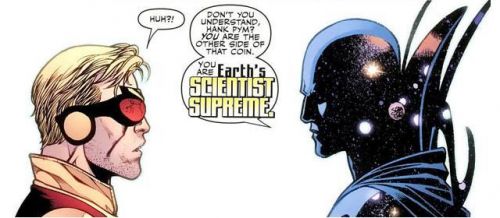
Are brains starting to become more valued than brawn? Originally from Comicvine
Are brains starting to become more valued than brawn?
Originally from Comicvine

In summary, we can leave some of the past behind us, but before we do that, we have to recognize just how much we cling to it. So while you’re celebrating this Batman Day out there with your capes and gloomy looks, don’t forget the real heroes of our times – the ones who are not macho, who don’t have bulging muscles, and yet like Batman they largely hide behind the scenery and do the dirty work that nobody likes to think about.

A School Is Engineering Children’s Brains with Electrical Current

Your child comes home from school, crying again. As you try to gently comfort him, he weeps openly on your shoulder – “The numbers won’t stop moving on the blackboard, and I couldn’t do my homework again and Tom said I was stupid!”

After a prolonged talk on the phone with Tom’s mother, you decide that something needs to be done. By now you know that your son has been diagnosed as suffering from dyscalculia: a difficulty in understanding numbers, which afflicts 3 – 6 percent of the population. But what can you do about it? If he had ADHD, you would’ve prescribed Ritalin for him, but there’s no easy and simple treatment you can give him to fix the problem. He’ll just have to work much harder than everyone else to understand math, because of the way his brain is shaped. That’s just the way nature works, right?

Well, we humans are particularly good at circumventing Mother Nature’s whims, and now there’s a new treatment for dyscalculia of a very different sort than anything else before it: basically, this treatment is all about re-engineering the brain of the child, from the inside.

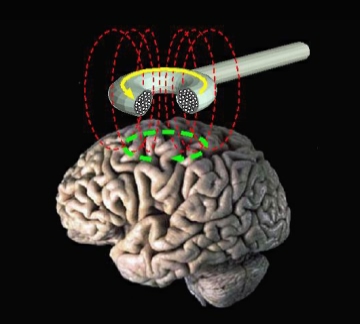
The treatment, which goes by the scary name of Transcranial Magnetic Stimulation (TMS), relies on a helmet that generates magnetic fields inside the brain. Those magnetic fields, which can be focused on small areas in the brain, can enhance or inhibit the communication of the neurons in those areas. Essentially, we’re performing a brain surgery from within the skull, without lifting a finger or using an invasive tool of any sort. And the results are nothing less than astounding.

Despite the fact that TMS is a relatively young technology (the first successful study using TMS was conducted in 1985), it has already been approved by the FDA to treat depression and migraine. The only problem with TMS was that it requires a strong magnetic field, which can be generated (currently) only by a large and cumbersome equipment. In short, this means that TMS can only be used in the lab.

Transcranial magnetic stimulation.jpg
An illustration depicting the magnetic field being operated on a human brain.

But we did say that humans are good at circumventing problems, right? And so, meet TMS’ more nimble brother, the Transcranial Direct Current Stimulation, or TDCS. The idea here is to deliver a low electrical current to the area of the brain you want to influence. Scientific studies have shown that by focusing on specific areas of the brain we can enhance language skills, attention span, memory and – yes, you guessed it – mathematical ability. What’s more, the technology can be used with a pinpoint accuracy, and without having any serious side effects (at least as far as we know).

You’re waiting at the school for children with learning difficulties. Your son sits in front of you, serene and calm, with his eyes closed. After twenty minutes, the school’s nurse removes the electrodes from his forehead, and he opens his eyes again and smiles. She shows him the numbers on a blackboard, and this time he reads them all fluently.


This scenario is not science fiction or fantasy. In fact, it’s happening right now. In a recent research conducted by Roi Cohen-Kadosh from the University of Oxford, twelve children at the Fairley House school received nine training sessions with a variant of the TDCS technology. Six of them received the actual treatment, and the rest wore the cap and the electrodes, but did not receive any stimulation. As expected, the children who received the stimulation reached significantly better mathematical achievements than their friends.

A child using Transcranial Direct Current Stimulation. Is this the new form of learning? Image originally from a blog post in Scientific American, by Gary Stix.

The Age of Brain Engineering

There is still a debate whether or not TMS and TDCS can be used to enhance the brain’s function to more-than-human levels, or ‘just’ to negate quirks in the brain like dyscalculia and ADHD, and elevate the person to the normal level of the population. But what are those ‘normal’ levels? Is that an IQ of 100? Or maybe 120, or even 150? Approximately half of the population has an IQ lower than 100. How much would they benefit from a weekly treatment that would jumpstart their brains to the average level?

The debate about human enhancement, therefore, largely misses the full consequences of brain-engineering technologies like TMS and TDCS. Those technologies allow us to engineer the brain, and what’s more – they’re becoming cheap and easy enough to use, that anyone who really wants to can use them. There are already companies working on bringing the technology to the masses, like Foc.us – a company that sells transcranial stimulators that should enhance the brain’s functions for gamers. There’s even a Youtube vid that shows you how to make a TDCS of your own for about 20 dollars (careful, I’m not endorsing that!)

Cohen-Kadosh himself is already envisioning a future in which people “…plug a simple device into an iPad so that their brain is stimulated when they are doing their homework, learning French or taking up the piano.” And while we are obviously not quite there yet, there is no reason we couldn’t get to that point within ten years. After all, Facebook changed the entire way people communicate in just ten years. Why not brain technologies, particularly when they are of the non-invasive sort?

Admittedly, these commercial technologies are still in their diapers right now, and are probably more razzle dazzle than real substance. However, as the technologies mature, we will gain the ultimate power over our brains, and will reach a time of Cosmetic Neurology – when we’ll be able to alter our moods, our abilities and our perceptions according to our wishes. This development might happen in ten or twenty or even thirty years from now, but when it comes, you, me and everyone else will need to answe the question: will we re-engineer our brains?

You’re back at the house. The kid is happily solving mathematical equations in his notebook, while simultaneously watching TV and chatting with his friends on Facebook. You, in the meantime, are still struggling with that new coding language the boss asked you to study this week. You’re tired and miserable from exerting your brain so much. You take a glance at the kid’s TDCS kit, which the school supplied you with, and for a moment… you wonder.

Tattoos, replacement limbs and body modifications – oh my!

Maggie had never worn shorts around her parents. She had a secret she never wanted them to find out about: under her clothes, her body is covered in secret tattoos. The tattoos range in size and shape, from a tiny cross-shaped drawing on her hip, to a large one covering her entire side, depicting a colorful heart with the words MOM and DAD etched above it.

Many people would view Maggie’s body and skin as beautiful, but her parents are conservative Christian folks. Maggie believes they consider tattooed people as people “…who probably dabble in drugs”. Nonetheless, when she decided to reveal her painted body to her parents, she found out to her great surprise that they accepted her, and that they had no problem with her tattoos.

When Norms Change

As Maggie’s story demonstrates, the public acceptance of tattoos in America has undergone a sharp change over the past fifteen years. In 1936, Life magazine assessed that only 6% of Americans had a tattoo. Today, the total percentage of American individuals who have at least one tattoo has more than doubled itself to 14%, and of all American adults aged 26 – 40, a whopping 40% are tattooed. That’s basically almost half of all the population at that age category.

Why are tattoos gaining in popularity all of a sudden? Nobody really knows. Some academics, like Anne Velliquette, believe that people use tattoos to adhere to a certain aspect of themselves that exists in the moment. In a recent article in The Atlantic, Vellinquette describes our current society as chaotic and fragmented, leading people to look for anchors to feelings and states of mind that will never go away.

Whether the explanation is right or wrong, the acceptance of tattoos in society demonstrates how quickly the horrors of the previous generation can become the norms of the present one. So here’s an interesting and entertaining question for us to consider: what body modifications that we view with horror today, will our children consider to be absolutely normal, and possibly even necessary for the expression of the self?

The list of possible body modifications can be quite large. It includes tattoos, ear stretching, horn implants, changing iris color, changing the color of your skin, and even implanting magnets under your skin, and hanging electric appliances on them. If you feel sure that one of these (or another which I haven’t mentioned) is going to become widespread in the future, feel free to say so in the comment section. In the meantime, I’d like to highlight just one category of body modification that has never been applied to a healthy human body so far – but may become a reality within the next few decades.

Replacement Limbs

You walk into a body modification parlor. All around you are samples of the art that you can graft onto your body: from colorful tattoos, to small horns to be implanted on the forehead. After spending a long time staring at the possibilities in front of you, you finally select one.

“I’ll take this robotic hand.” You tell the modification artist. He explains to you, slowly and carefully, that to graft the hand onto your arm he would have to remove your biological, original hand, fingers and all. You just shrug. The biological hand you currently possess has way too many tattoos on it anyway, of past memories you’d rather forget.

This scenario is obviously quite detached from the present, in which every kind of surgical intrusion into the body is considered taboo without a good medical reason. However, the taboo is there for a very specific reason: to protect people from undergoing medical procedures that could expose them to infections. According to the CDC, even if you’re being treated in the most sterilized surgery rooms in the world there’s still a chance of somewhere between 1.9% and 3% for infection.

Let us assume that medicine is about to experience exponential development in the next few decades – an assumption that is very hard to dispute, but which is a topic for another blog post. Such exponential development would result in a society in which infections are a thing of the past, body parts are being grown in vats or printed fully, and robotic prostheses can be implanted onto the body and complement it just as well as our biological limbs do.

There are hints that this future is starting to become true. The most sophisticated prostheses currently are probably made and programmed by Hugh Herr – a professor in the MIT Media Lab, who is also a double amputee by himself. He has designed his own bionic legs and feet, and changes them as though they were fashion items, in order to become taller, shorter or more fitting for mountain hiking. His bionic legs are sophisticated enough that people can actually use them to dance, as though they were real limbs.


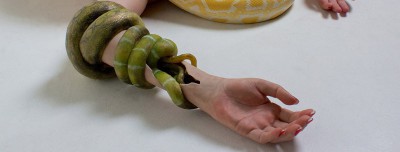
Prostheses that are also forms of art start making their way into the public awareness. Models with bionic arms walk the runways at top fashion events, and they no longer bother using a look-alike prosthesis. Instead, they opt for prostheses that – like tattoos – have a deeper meaning. The Alternative Limb Project actually produces prostheses that look intentionally bizarre and extraordinary. And while such prostheses must be extremely expensive, the Makers Movement is starting to 3-D print fully functional prostheses for a few hundred dollars. Some of those ‘house-made’ prostheses will doubtless be drab and grey; others will be as individual as can be, and will come in the shape of robot arms, animal arms, arms with drawings (tattoos?) on them, and many other variations.

An alternative prosthetic arm, that includes snakes going through it. According to the wearer, Jo-Jo Cranfield, “My alternative limb is so different to any other prosthetic limb I have ever had. I wear it with pride. I’ve never seen a two armed person with snakes crawling into their skin, and even if I did I don’t think it would be so comfy! My alternative arm makes me feel powerful, different and sexy!” Credits: the arm was created by Sophie de Oliveira Barata and fitted at Queen Mary’s Hospital The make-up artist for the picture was Gemma Fee, and the photograph was taken by Rosemary Williams. The picture (and many others like it) can be found at the Alternative Limb Project site.

Considering the need for prostheses in society, and the advances in technology, it is clear that we are going to see many more amputees going around with robotic or static limbs that will better reflect their character, occupations and needs. Will we ever reach a state when healthy people actually ask to remove their limbs and replace them with alternative ones? That will take some time, but ultimately I cannot see a good reason against such a social development.

The Impassible Barrier?

At this point you may be asking yourselves: where do we stop? Are there kinds of bodily modifications that society will shun forever? The fact of the matter is that “Beauty is in the eye of the beholder”, and the beholder is part of a larger social construct than herself. Tribal societies throughout the world have come to the conclusion that stretched ears are beautiful, or that scrotal implants (be careful: after I Googled that one up, I got some really weird ads in my browser) look sexy. Western society seems to be going with tattoos right now, and with unnecessary enlargement of women’s mammary glands by way of breast implant. So yeah, we are definitely up for altering and modifying the human body. The only question is how, and when.

Considering all of the above, who is to say that stretched ears, or alternative prostheses, won’t become part of our future? Bodily modification has been part of all societies so far, and it is only expanding. The current generation will always be disgusted, repulsed and visibly shaken by novel changes to the human body. And the next generation? They’ll consider those changes perfectly normal.

One thing for certain: the future of the human body is going to be much more colorful, vibrant and heterogeneous than it is today.

Quite honestly, I cannot wait for the future to come.

The Fall of Skype: A Lesson for the Future?

Earlier today, people throughout the world found out that Skype just wouldn’t work for them. They couldn’t see their contacts online, they couldn’t call them, and their sole comfort was a laconic message from the program – “We’re a bit overloaded right now… Please try again later, or download Skype to use it any time.”

Admittedly, that’s not much of a comfort.

While the UK and Japan bore the brunt of the disconnections, people all over the globe were affected by the outage. Skype is truly a global phenomenon: it brings together more than 300 million users, and has been downloaded 500 million times from Google Play alone. By the year 2014, it had 4.9 million daily active users. For each minute Skype is offline, the firm behind it is losing thousands of dollars. It stands to reason that the engineers behind the system have developed multiple layers of defense against failure. And yet they all failed, resulting in an 11 hours shutting down of services.

What can we learn from this event?

First, that complex systems – a term that covers basically all the transportation, communications and healthcare systems we have today – are bound to fail at some point. Richard I. Cook, Professor of Healthcare Systems Safety, explains that complex systems “contain changing mixtures of failures latent within them”, and hence – that “catastrophe is always just around the corner”. At one point in time, a few latent failures rise up together in an unexpected way, and cause a catastrophe that surprises everyone involved.

Secondly, we have systems that encompass practically the entire world, and yet are controlled hierarchically or communicate with each other in a way that a failure in one zone could cascade to many other areas worldwide. Skype is one such system, and so are the GPS satellites, and the global stock market as well.

Thirdly, we need to prepare future scenarios that take into consideration some extreme occurrences: what happens if Uber’s services, for example, are no longer available because of a system failure? In cities like San Francisco where 65% of traditional taxi business has been replaced by Uber drivers, the sudden crash would strand many travelers, particularly those who rely on their smartphone as a payment method (since Uber is deducting the price of the ride automatically from a person’s account).

Similarly, what happens if the GPS satellites somehow switch off? This possibility is not the stuff of science fiction movies, since most of the GPS satellites are long past their designated lifespan. If somehow the GPS keels over, almost all aspects of our life would be disrupted. Uber taxi drivers won’t know where their clients are, many people will find themselves on the road in their cars desperately trying to find an actual paper map, trucks will miss their shipments, tractor drivers in widespread farms won’t know where they are; cargo and leisure ships will become momentarily lost in the ocean, and so on.

Do these scenarios seem overly dramatic to you? Unbelievable, maybe? Well, it just happened to Skype. And it will happen again to other firms and services, somewhere, sometime in the future.

This forecast is particularly alarming in light of the fact that we are creating automated systems that control our daily lives in a time resolution of mere seconds. For example, we are going to enjoy the use of driverless cars sometime in the next five to ten years. How will such vehicles act when they’re suddenly all disconnected from their servers? Will they all stop in the middle of the street, blocking the roads for everyone? Will they complete one last trip and then try to park safely… along with all the other hundreds of thousands of driverless cars in the street? These are questions that we need to consider ahead of time, in order to develop more robust global systems.

How do we deal with such potential failures in global systems? The usual response in the present is to add layers of defense mechanisms, which are fine at delaying the catastrophe for some time, but can never negate completely the chance of it happening. I would suggest that an additional course of action would be to add redundancy to service providers, so that no single service provider can become a worldwide monopoly in any critical field. This line of thinking is possibly the reason that China, India and Japan, among others, are currently planning to launch and operate a navigation system of their own… just in case something happens to the GPS satellites.

Skype has made a comeback within eleven hours, and the world is buzzing with international video conferences again. We should, however, keep in mind the words of Paul Romer – “A crisis is a terrible thing to waste”. We should learn from Skype’s momentary disappearance to better prepare for the future, and avoid concentrating too much power and control in the hands of a single firm, system or infrastructure.

Roey Tzezana, PhD, is a Futures Studies researcher at the Blavatnik Interdisciplinary Cyber Research Center (ICRC) at Tel Aviv University. He’s currently studying and developing scenarios for the future of crime in the age of the Internet of Things. His full information can be found at www.guidetofuture.com