
Why crowdfunding scams are good for society

Yesterday I suggested a scenario about the Skarp laser razor campaign, in which the new device disrupts the current shaving industry giants. Well, that was yesterday. Less than 24 hours after I published the piece in this blog, Kickstarter suspended (a polite word for “dumped”) the project. The people behind Skarp jumped ship immediately to Indiegogo, and seem to be doing quite well in there – gathering approximately $10,000 every hour, for the past ten hours.

There have been several accusations by so-called experts and professional experts in the field of lasers and physics, regarding the feasibility of the laser razor. And yet, the suspension by Kickstarter was formally because of a very different reason: it turns out the Skarp team did not have a working prototype. Or maybe they did, but it was working so haphazardly that it could not be used for actual shaving.

So what’s going on here? Don’t the folks at Kickstarter consult experts before they agree to take up projects that may be physically impossible?

I believe they do not, and that’s generally a good thing.

In order to understand why I say so, let’s first try to see what purpose Kickstarter and crowdfunding platforms as a whole serve in society.

The Three Steps of Innovation

We often hear of the entrepreneur who had an amazing idea. A truly breathtaking invention formed in his mind, and he immediately proceeded to make it a reality, earning himself a few billion dollars and a vacation in the Bahamas on the way.

That, at least, is the myth.

In reality, innovation is based on three distinct steps:

  • Recombination of existing concepts into many new ideas;
  • Finding out which ideas are good, and which aren’t;
  • Rapidly iterating a good idea until it becomes an excellent one.

The Polymerase Chain Reaction (PCR) is an example for a unique recombination of existing concepts that changed the world. The PCR device is used in nearly every biological lab as part of the work needed to sequence DNA, to create new DNA strands, and genetically engineer bacteria, plants and even human cells. The technique was invented by Kary Mullis, who won the 1993 Nobel Prize in Chemistry for it, ‘simply’ by recombining existing techniques and automating them to a degree.

Many other winning inventions are in fact a recombination of existing ideas. Facebook, for example, relies on the recombination of a social network, the World Wide Web, smartphones, image and video storing, hashtags, and many others. Similarly, autonomous (driverless) cars are a recombination of computers, sensors, image processing, GPS, etc.

Since we’re constantly innovating, dozens (and sometimes hundreds and thousands) of new ideas are being added to the mix every year, and entrepreneurs are trying to recombine them in different and exciting ways to create new inventions. This is the first step of innovation: the frantic recombination of existing ideas by inventors from around the world.

The only problem is, most of these new inventions are, well, rubbish.

In his book “How to Fly a Horse”, Kevin Ashton (the inventor who gave the Internet of Things its name) details what happens to newly patented inventions in at least one firm – Davison Design. For the past 23 years, Davison mainly took money from customers to register their patents. Overall, its revenues equaled $45 million a year, with an average of 11,000 people signing with the company. How many people actually made any money from their patents and inventions? Altogether, only 27 people have seen any money out of their patents. The statistics, in short, are grim for any inventor. You may think the market is eager to use your new idea, but you can never tell for certain until the product is actually on the market. In fact, Shinkhar Ghosh from Harvard Business School has discovered that, “About three-quarters of venture-backed firms in the U.S. don’t return investors’ capital”. So nobody knows which idea is going to be any good: not even the big venture capitalists who invest millions of dollars in those ideas.

This is where the second part of innovation comes in: we have to winnow the good ideas from the bad ones. In the past, this function was only performed by government grants and investors. Distinguished committees would go over hundreds and thousands of idea submissions, and select the ones that seemed to have the best chance for success. Unfortunately, such committees are hard-pressed to support all the applicants, and as a result, 98-99% of ideas are refused funding.

Consider, on the other hand, Kickstarter and other crowdfunding platforms. In Kickstarter alone, 43% of campaigns reach their goals and obtain the money they needed to make their vision a reality. In a way, crowdfunding allows inventors to test their ideas: does the public want this new invention? Is it any good? Are people willing to pay for it… even before the factories have received the million dollar contract to manufacture all the parts?

In that way, crowdfunding platforms enable innovation by streamlining the second step: distinguishing the good ideas from the bad ones. And once a good idea has been found and supported – whether it’s an ice chest with a USB charger, or a pillow that covers the user’s head completely – the inventor keeps upgrading and changing the product so that it becomes better with each iteration. This is the reason that iPhone 6S is so much better than the original iPhone.

Innovation is the steppingstone on which our modern day society is built. Innovation leads to increased productivity, and as Paul Krugman says – “Productivity isn’t everything, but in the long run it is almost everything.” Innovative new companies are responsible for the majority of new jobs in the United States, and innovative ‘crazy’ ideas – the kind only few dared to support when they were originally proposed, like Airbnb or Google – have led to wholesale changes in the way society behaves.

Today’s new Google or Airbnb would not have had to look for elite investors: they could’ve went to the crowdfunding platforms to ask for assistance, and their chances would’ve been much higher to receive funding, at least in principle.

That is why Kickstarter is so important for innovation and for modern society: it allows the public to support many more innovators than ever before. And while quite a few of them are going to fail (probably most of them), the ones who make the big breakthroughs are going to change society. At the very least, even the fluked campaigns show the rest of us the value of some ideas. Overall, crowdfunding platforms move society forward.

The Bad Apples

“That is all just swell,” you might say now, “but how can we be sure that the projects on Kickstarter are not a scam? How can we know for sure that the Skarp laser razor isn’t a scam? The experts were all against it!”

Well, here’s a newsflash: when it comes to innovation, you can’t always rely on the experts.

There are plenty of examples that support this statement. Both Lord Kelvin (noted British Physicist) and the great astronomer Simon Newcomb dismissed any attempt to build a heavier-than-air flying machine, a mere two years before the Wright brothers demonstrated the first successful airplane. The British Royal Astronomer Richard van der Reit Wooley has declared confidently that “Space travel is utter bilge” – one year before Sputnik orbited the Earth. In fact, experts are wrong so often about the limits of possibility, that Arthur C. Clarke has issued his First Law about them –

Arthur C. Clarke's First Law. Originally from IZQuotes
Arthur C. Clarke’s First Law. Originally from IZQuotes

In short, experts can be wrong, too, even in matters as rigid as the laws of nature and the ways we can manipulate them. And it is so much easier to get social developments and innovations wrong, since there is no perfect model of the human mind or of society. And thus, no expert would’ve forecast with certainty that people will upload their photos so that millions can see them (Facebook, Flickr, Instagram), or share their houses (Airbnb) and cars (Uber) with total strangers. And yet, these innovative start-ups made it into existence, and changed the world.

That does not mean, of course, that the public should support every wily promise on Kickstarter. In fact, I think Kickstarter did a good thing when they removed the Skarp project because the inventors had no fully working prototype. In the end, crowdfunding platforms need to balance between the desire to protect their users from scams, and the fact that it’s very difficult to distinguish between scams and some extremely innovative ideas. At least in this case, it seems Kickstarter decided to err on the side of caution.

Conclusion

While many are asking whether the Skarp laser razor is a scam, it’s the wrong question. The real question is what purpose Kickstarter and other crowdfunding platforms should have in our modern society, and the honest answer is probably that the users of these platforms have a better chance of seeing their money dissipating into thin air – but altogether that’s a good thing, since more innovators overall get supported – and the few who succeed, change the world.

So go ahead: support Skarp on Indiegogo, or any other crazy idea on Kickstarter, Tilt and the other crowdfunding platforms out there. Buy that new (barely functioning) 3D-printer, the shiniest (and fragile) aerial drone, or that dream-reader that doesn’t really work. Go ahead – now you have the justification for it: you’re promoting innovation in society. Or in other words – bring on the scams!
The Laser Blade that Could Tear Down Gillette and Schick

Shaving is one of the great hardships of my life (and I guess I should consider myself lucky that this is one of my top worries). Up until recent years there have only been two giants in the shaving market: Schick and Gillette. Both are engineering their razor blades with space-age technology, promising you a blade that looks and feels as if it were found floating in space, shining magnificently in the Sun’s bright rays.

And it stings. Oh, how it stings my skin.

Both companies are trying to minimize cuts to their customers’ skin, obviously, but getting the nicking frequency down to zero is a daunting task, and probably impossible. We’re dealing with blades here, after all, sharpened to the point where they could (allegedly) cut air molecules in twine. As the book of Proverbs admonishes us: “Can a man carry fire in his lap, without burning his clothes?”

I would think that the burning clothes would be of the least concern to the guy carrying fire in his lap (please don’t do that), but the point is clear. You play with fire, you get burned. You play with razors, you get cut.

Well, then, why don’t we change the paradigm of using a razor blade for shaving? That’s exactly the idea behind the Skarp Razor project, which has recently surged to new heights on everybody’s favorite crowdfunding platform: Kickstarter.

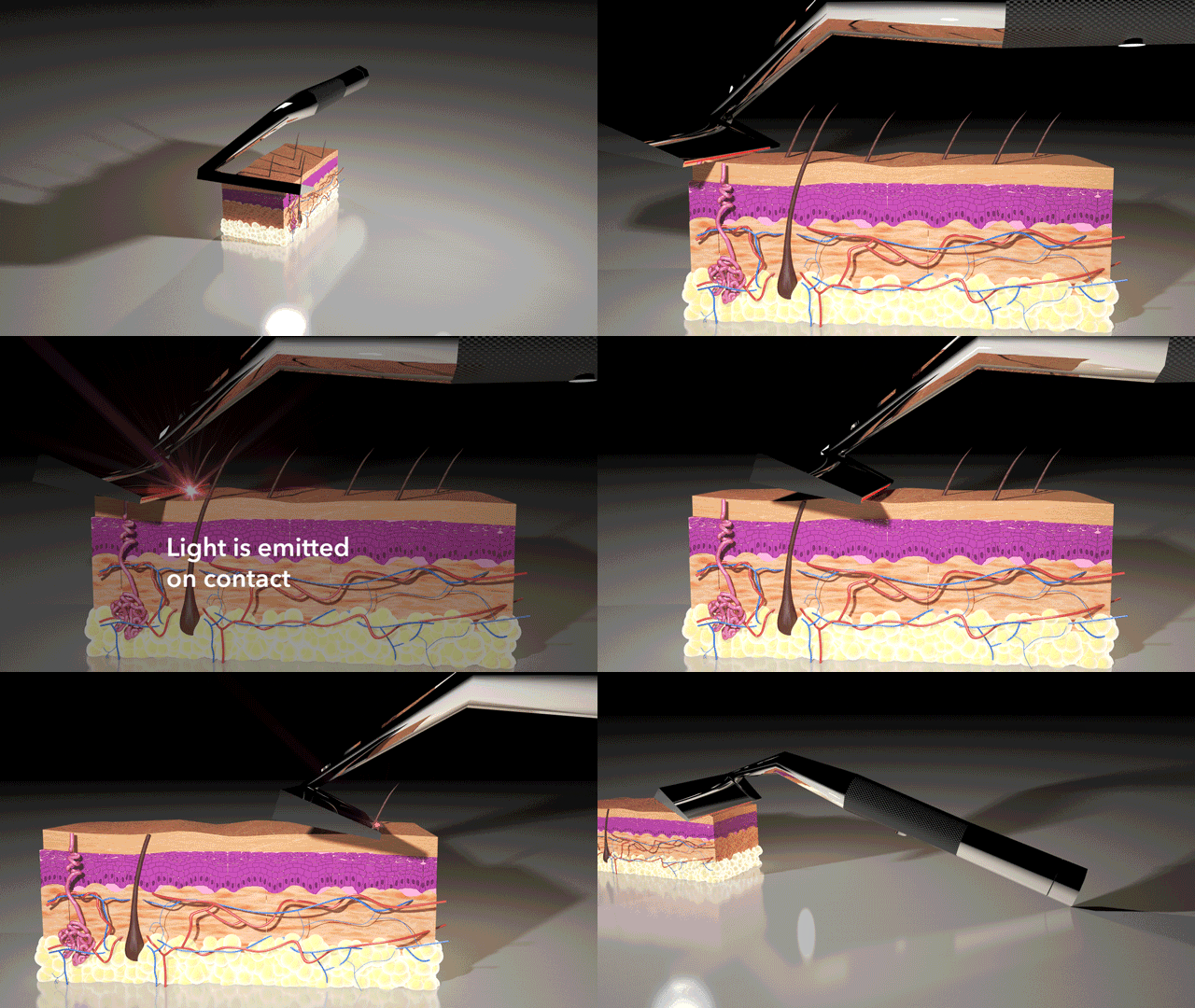
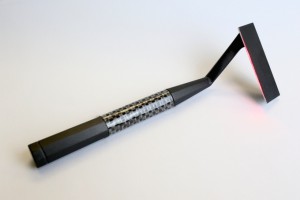
The basic idea is pretty simple. Instead of blades, the Skarp ‘razor’ is utilizing a small laser beam with a wavelength that was selected specifically to cut human hairs. It does not cut or burn the skin, needs no shaving foam, and only requires one AAA battery every month. Those, at least, are the promises on the campaign site.

The Skarp Laser Razor - a virtual demonstration, from the Kickstarter campaign site.
The Skarp Laser Razor – a virtual demonstration, from the Kickstarter campaign site.

The inventor behind the new blade, Morgan Gustavsson, has worked in the medical & cosmetic laser industry for three decades, and invented and patented the most common method for hair removal using laser in cosmetic beauty salons. Now he’s perfected and miniaturized the technology (again, according to the campaign’s claims which should be taken with a grain of salt) to bring it to everyone’s households.

If the Skarp Razor actually delivers on the promises made, the consequences would be used, and would essentially disrupt the stagnated shaving industry. Schick and Gillette have both competed under a very limited paradigm: shaving is to be done with blades only. Their entire business model revolves around the sale of high-priced blades. How can they handle a competitor that sells only one razor that should last for nearly a lifetime of shaving?

Short answer: they can’t, at least not under their current business model. Unless they find a new breakthrough technology of their own, their business model will be disrupted within a year, and they may well find themselves on the ropes in five years or less. This may be yet another Kodak Moment: a huge industry giant in its field, which gets disrupted following an innovation that reaches to the masses (digital cameras in smartphones), and declares bankruptcy five years later.

The possible disruption of this $4.13 billion market reveals an important principle of today’s industry, which has been mentioned before by Peter Diamandis, founder and chairman of the X-Prize foundation and co-founder of Singularity University: “If you don’t disrupt yourself, somebody else will.”

This principle is particularly relevant in the case of Schick and Gillette. The two giants have not faced any real competition except for each other for a long time now, and were thus unwilling to change their basic operating paradigms. They innovated, decorated and re-innovated their blades, but they did not find new ideas and concepts to re-think the process of shaving. Now, when the laser blade makes an appearance, they will need to frantically look for new answers for the threat.

Of course, nobody can forecast the future accurately, and the new laser shaving technology defies any attempt at foresight right now because we don’t know how it works exactly. Furthermore, the initial product that will be delivered to consumers next year is bound to be in a preliminary state: primitive and rough, and almost certainly disappointing for the wide public. The Skarp 2.0 will be infinitely better and more suitable for the needs and wishes of the consumers – but only if the company survives the first disappointment.

Conclusion

We can’t know yet whether the Skarp Razor is about to disrupt the shaving industry, especially since at the moment it’s no more than a promise on a crowdfunding site. However, if the invention does have merit and proves itself over the next year, the shaving industry giants will find themselves in a race against a new technology that they were not prepared for. I, for one, welcome such competition that will lower the prices of blades, and force the old guard to re-innovate and rethink their existing products and business models. I don’t envy the people at Gillette and Schick, though, for whom the next decade is going to be a hair-raising rollercoaster.

Virtual Reality Will Take Gaming Outside

Featured image by Phil Whitehouse on Flickr

One of the complaints I hear most often from concerned parents, is that their kids spend most of their time in the virtual world. Their eyes are constantly glued to their smartphone’s screen.

“How can those kids live like that?” They demand to know. “Are we raising a new generation of zombies, totally dependant on their screens?”

My answer, always, is to remind them just how recently ago smartphones appeared on the world stage. Until 2007, there were no smartphones for the public. That means that this innovation is basically eight years old – a ridiculously short period of time compared to the history of humanity, or even to disrupting innovations like trains or cars. We’re still figuring out how to use the smartphones, well, smartly, and how to engineer our gates into the virtual world. And I tell those concerned parents that in ten years time, their children won’t look into their smartphones to find the virtual world, but will find the virtual world coming to them instead, unbidden.

To understand what I’m talking about, you just need to take a look at one of the hottest scenes in technology today: the virtual and augmented realities (VR and AR). Devices like Oculus Rift, Vive and Samsung Gear VR are coming to the consumer market in this year and the next, and the experience they provide is like nothing we’ve seen before. Trust me on this one: I’ve tried both the Rift and the Gear VR, and found myself swimming in the ocean with whales, visiting Venice, and running from real-life monsters in a temple… without actually getting up from my chair.

A trailer sample of the new generation of VR headsets: the HTC Vive, created by HTC and Valve

The forecasts for the virtual reality are incredibly optimistic, with Business Insider estimating that shipments of VR headsets will double in number every year, and will create a $2.8 billion hardware market by 2020. The Kzero consulting firm has forecast that annual revenues for VR software will reach $4.6 billion by 2018. This growth rate leaves the iPhone’s far behind, and will mean that – if those forecasts are anywhere near accurate – VR is about to take the world by storm in the next three years.

A forecast by Business Insider for the near future of VR devices. Notice the 99% cumulative annual growth rate - which essentially means a doubling of the number of shipments every year.
A forecast by Business Insider for the near future of VR devices. Notice the 99% cumulative annual growth rate – which essentially means a doubling of the number of shipments every year.

For myself, I’m still hesitant to believe that the VR market can rise so rapidly to prominence. The VR devices, while creating beautiful sceneries for the users to explore, are still cumbersome to wear on the face, and leave you disconnected from your immediate surroundings. So I prefer to stick to the old adage (allegedly by Arthur C. Clarke, and later proven by research in foresight) – “Experts are too optimistic in the near future, and too pessimistic in the long-run.”

These limitations will change in the future, and will most probably lead to the creation of augmented reality (AR) devices, which will look more like a normal pair of glasses, but with the pictures being displayed on the glasses themselves. In that way, the user will be able to see the physical world, along with the virtual world being overlaid on it.

Such AR glasses as described are already in existence, though they are still quite limited in capabilities. The Lumus glasses do just that, as do the Meta glasses. While both are still clunky, cumbersome, and have a limited field of view, they’re the early birds in the AR-Glasses field. If we assume that technology will keep on progressing (and honestly, I can’t see a way for it to stop!), we can be sure that the next AR-Glasses will be thinner, more energy-efficient, and more usable in general.

Let’s talk a bit about the games that AR and VR could open up for us in the future.

Gaming and VR / AR

Using VR for gaming is a no brainer. In fact, that’s the main use analysts are thinking about for VR in the next five years. Imagine running in the virtual landscape of Azaroth in World of Warcraft, or climbing the virtual towers and cathedrals of Paris in Assassin’s Creed. Those are experiences that will make the hardcore gamers flock to VR.

However, I would like to consider a different sort of gaming – one that might be accomplished by means of AR. The gamer of the not-so-far-away-future may actually be the athletic sort, because many games would be played on the streets of the city. By using AR-Glasses, every player would see a different image of the street: some will see the street as a dungeon with a dragon at its end, while others will find themselves forced to evade virtual deadly robots on the prowl, and still others would chase virtual butterflies on the pavement. Admittedly, that’s one crowded street!

Ok, this idea sounds a bit silly when you consider all the human congestion and potential traffic accidents that could occur, but there is definitely a case for streets and physical infrastructures that would be used as playing ground for the hard-core gamers. Even ‘soft gamers’ like most of us could find themselves taking a walk or a jog in seemingly-ordinary streets, with the AR-Glasses in our eyes turning the jog into a run from a dragon (with extra points if you make it out safely!) or involving some interesting activity while walking, like finding and picking up virtual playing cards on the pavement.

There are tantalizing hints in the present for this sort of outdoors-gaming. The “Zombies, Run!” game for the smartphone, is all about being chased by zombies in the real world. The zombies, of course, are virtual and you can only hear them behind you as you run, with the narrator giving you missions. Also, the more you run, the more supplies you collect automatically to build up your base. Another app, by the Mobile Art Lab in Japan, lets you see butterflies through your iPhone’s camera, and swipe at them to catch them – and turn them into discount coupons for restaurants.

Perhaps the most impressive example (although it’s more of a publicity stunt than anything else) of what augmented reality could do for the gaming world has been shown recently by Magic Leap – an AR company, obviously. Take a look!

Obviously, these are only hints for the future, but they’re pointing at an amazingly colorful and fascinating future for us all. The virtual world will no longer be far away from us, or force us to take our smartphones from our pockets. Rather, it would be all around us, and we’ll be able to see and hear it via the AR-Glasses and earbuds that we carry all the time.

The Challenges

Why isn’t this future not here by now? The challenges can be divided into two sorts: technological challenges and societal ones.

The technological challenges consist mainly of battery limits, which have been the ban of smartphones and other wearable computing so far. In the case of highly-sophisticated equipment such as AR-Glasses, the size of the projectors that send pictures to your eyes or onto the glasses is also a problem, and makes for extremely unfashionable glasses. Interestingly, the computing power does not seem to be a real challenge on its own, since AR-Glasses and other wearable computing devices could use the smartphone in one’s pocket to do most of the toughest computing tasks for them… which brings us back to the need to invent more efficient and long-lasting batteries for the smartphone as well.

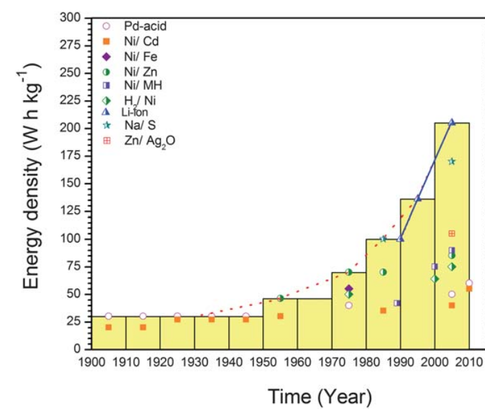
None of these technological challenges represents an impassable barrier. In fact, if there’s one thing we can promise, it’s that future devices will have more efficient batteries, and will have the potential to be smaller. The trends indicate clearly that batteries are rapidly making progress towards better energy density.

The growth in batteries energy density over time. Originally from "Thermodynamic analysis on energy densities of batteries"
The growth in batteries energy density over time.
Originally from the paper “Thermodynamic analysis on energy densities of batteries“, which was brought to my attention in Quora.

The other big challenge is the societal one, and this is where Google Glass crashed into a wall. People simply did not like the fact that the person they’re speaking with could take a picture or a video of them at any time, or may even watch porn during a face-to-face conversation. The design of the Google Glass itself did not do anything to ameliorate those anxieties, and thus people just stopped using the Glasses to avoid becoming social pariahs.

While many believe the Google Glass has completely failed, we must remember that every device begins as a partial failure, since nobody knows how it will be used or how people will react to it. Google Glass was an experiment in design, and Google is now working relentlessly towards Google Glass 2.0, which will fit better with people’s desires and uses.

In short, while there are still challenges to the AR scene, they will be solved sooner or later. Any other conclusion forces us to think that somehow technology will cease to evolve and that companies will stop adapting their products to the consumer market, and I don’t see that happening anytime soon.

Conclusion

There are plenty of uses for virtual and augmented realities other than gaming, and in future posts we’ll deal with them as well. For now, I hope I’ve convinced you that at least part of the gaming activity would not take place solely in front of a screen, but in the streets and the parks. It’s going to be a pretty interesting world to live in, full of colors and messages and experiences that will blend seamlessly with the physical world.

And wouldn’t you like to play such games?

Systematic Inventive Thinking, and Ways to Use Genetically Engineered Plants for Advertising

While visiting the Roger Williams Park Zoo in Rhode Island, I happened to take this photo of genetically modified pumpkins displaying a wide range of advertising materials, apparently for the corporate sponsors of zoo activities.

A Genetically Engineered Pumpkin Advertisement, from the Roger Williams Park Zoo in Rhode Island. (Well, they're more of the ordinary painted/carved pumpkins, but it sounds way cooler when you think they might be engineered to produce these writings)
A Genetically Engineered Pumpkin Advertisement, from the Roger Williams Park Zoo in Rhode Island.
(Well, they’re more of the ordinary painted/carved pumpkins, but it sounds way cooler when you think they might be engineered to produce these writings)

Well, obviously the pumpkins aren’t actually genetically modified – they were just painted or sculpted by human artists – but in the rate genetic engineering is progressing, it’s quite possible that in a few decades we will have genetically modified fruits and vegetables that actually display readable advertisement on them as they grow up.

Now wouldn’t that be interesting?

I decided to take this chance and consider innovative ways in which future GMOs (Genetically Modified Organisms) could be used to promote and advertise products, ideas and corporates. In order to do that I utilized a fascinating systemic thinking system for innovation around which an entire consulting company called SIT (Systematic Inventive Thinking) was founded.

The principles of the SIT system have been described in a 2003 article in Harvard Business Review. In short, the main idea is to limit your creativity instead of trying to stretch it sky-high. Why is that so important? Consider that you’re on a first date, and the girl (or boy) is leaning forward across the table and is asking you that ages-old question: “Tell me about yourself!”

If you’re like most human beings, you probably freeze in complete bewilderment, unsure where to begin or to end, and what you should actually talk about. You’re lost in the chaos of your own mind, sinking below the waves of many thoughts and impulses: should you tell her about your trip to India? Or maybe about your ambitions for the future? Or maybe she really wants to hear about your bar-mitzvah?

Coming up with creative and innovative ideas is similar to dating, at least in this view. Many executives tell their staff to find and implement creative ideas in their product, leaving them floundering and resentful. Many (too many) creativity workshops look that way too: with round tables of employees and executives who are told to be creative and just to “think up a new innovative product for the company!”

Such exercises rarely lead to good results. At best, the participants fall back on whatever ideas they’ve read or thought about before, and almost no new or innovative notions are being produced at those meetings.

Now consider the alternative dating scene: your date asks you a very simple question – “What did you eat this morning?” In this case, the answer is clear. You have a starting point that is safe and sound, and while admittedly it is not very interesting, the conversation and the jokes can start flowing from that point onwards. It works the same way with creativity: by putting constraints on your thinking process in a systematic fashion, you’re actually capable of analyzing the situation in an orderly way, and develop each innovative case fully at a time.

The SIT method places constraints over the innovation process by forcing the thinkers to consider innovative changes to the current product in only five different directions: subtraction, multiplication, division, task unification, and attribute dependency. Let’s go over each one to think up innovative ways GE plants could be used for advertisement.

SIT Thinking Tools

Subtraction

Subtraction means that instead of our natural tendency to add features to an existing product, we remove existing features, particularly the kind that seem vital and necessary.

How does this thinking tool relate to GMO? Well, what would happen if we were to engineer a fruit without its skin or outer covering? The skin of the fruit obviously serves to protect the soft and squishy interior, so it’s definitely an important part of the product. However, maybe we could make the skin thinner and translucent, so that the consumer would see what they’re getting inside the fruit: they’ll see whether the banana has dark stains on its edible part, and if the tomato is rotten or has worms. That would certainly be an interesting advertisement maneuver: “We don’t have anything to hide!”

Multiplication

By applying the multiplication thinking tool, we multiply – add more copies of – certain existing components of the product, but then alter them in a significant way. Gillette’s double-bladed razor is a well-known example: they added an extra blade, and then found a different use for it on the other side of the razor.

How about, then, that we engineer the fruit to contain more seeds – but ones that are actually viable, and grow into some interesting and different kinds of fruit? The fruit’s manufacturer could bring the fruit to market as a tool for teaching children about the natural world, and even create a competition to find that “one golden seed” hiding in every one fruit out of a hundred, and out of which a truly extraordinary fruit will grow.

Division

The division tool makes us divide the product into its separate components – and then recombine them in some new way. In the case of genetically modified fruit, we can roughly separate the ‘product’ into seeds, edible flesh, skin and a stem. How can we mix the three to make the final product more valuable for advertisers? Here’s an idea: make the seeds grow on the surface of the fruit, but make them as small as speckles, adding a shine to the fruit. Or maybe make the stem go through the entire fruit, like a skewer, and promote the fruit as one that can be easily roasted over a grill.

Task Unification

Which two tasks can be unified into a single component of the fruit? This one is easy: make the stem tasty, so that it can be eaten as a snack next to the fleshy fruit. One can also imagine fruits that contain therapeutic materials, so that eating them serves a double purpose: get thin, and get healthy.

Attribute Dependency Change

The components and attributes of every product depend, in part, on its environment. Shoes for girls, for example, often come in pink (attribute: color). Watermelons are often sold in summertime, which is another relation between an attribute (time of sale) and the product.

Using this thinking tool, we can really go wild. If we only focus on color as an attribute, we can engineer fruit that changes its color visibly when it’s infected by certain bacteria, or that its color can tell when the fruit was picked up from the field, assuring the consumer that they’re getting fresh produce. And this is just the beginning, since we can also play with the smell, touch, and even weight and size of the fruit. So many opportunities here!

Conclusion

You may or may not like the ideas I gave for genetic engineering of plants. Regardless, this post was primarily an exercise in innovative thinking meant to provide a sneak peek at a wonderful methodology for innovation. You are warmly invited to suggest more ideas for genetic engineering of plants in the comments section, using the SIT methodology as a guide. And of course, you can use the principles of the SIT Methodology to innovate your own ideas for a product, service or company.

I’m sure you’ll make good use of the methodology, and will discover that innovating under constraints is as useful as it is fun.

Enjoy!

First Human Undergoes a Genetic Engineering Treatment to Reverse Aging

Somewhere in the world, in an undisclosed location, an individual is being genetically engineered right now in order to fulfill humanity’s long-time dream: to reverse biological aging, and become young again. The treatment is provided by BioViva, a small company with incredibly large dreams.

BioViva’s CEO, Elizabeth Parrish, announced that the treatment is composed of two different therapies, which have been developed and applied outside the USA. The patient is doing well at the moment, and will be routinely checked and evaluated, so that within twelve months we can expect some preliminary results.

I wrote a lot in the past about the future of radical longevity – i.e. extending the lifespan of ordinary human beings to a hundred years and more. The field excites me – and quite frankly, if you’re not exhilarated about any progress at all that happens in the field of life extension, then you must have completely managed to forget that you’re going to die someday from old age. Yeah, sorry about that.

I contacted Parrish and requested an interview, and she was kind enough to grant it, and to reveal a vision for humanity’s future that is truly radical and fascinating, but may well come true within the next few decades. It is a vision in which humanity largely eradicates old age and diseases, reaches equality between human beings and nations, and dares greatly in order to achieve greatness.

Disclaimer: I edited the quotes by Ms. Parrish for clarity.

Elizabeth Parrish, CEO of BioViva. Image originally from BioViva.

Are They for Real?

After reading all the above, you would be justified asking: is Parrish and her company for real? Are they the real deal, doing actual science instead of general quackery?

While there is no way to know for sure, BioViva’s scientific advisory board contains some highly influential and prestigious scientists in the field of synthetic biology and longevity. It includes Prof. George Church from Harvard Medical School, who is one of the top experts in the world when it comes to genetic engineering. You can also find in there Dr. Aubrey de Grey – an advocate and a prophet of radical longevity.

The treatment enacted by BioViva, while still largely kept under wraps from the public, involves a combination of two different gene therapies: telomerase induction and myostatin inhibition. Telomerase controls the internal clock of each cell, and there’s evidence that myostatin inhibitors can reverse the accumulation of atherosclerotic plaques in veins. “We have that data in animals and in humans, but we need to run a clinical trial.” Says Parrish.

That is where the patient – the one receiving the combined therapy – comes into the picture. Apparently, he is a volunteer who has decided to sacrifice – or enhance – his body for science. While Parrish is reluctant to reveal his identity, she agreed to say that he’s in his 40s, and relatively healthy.

“We believe it is perfect because we could work with someone who was not in the worst stage of illness.” She explains.

The experiments are taking place outside the U.S. since “we didn’t want to deal with legal issues giving the treatment in the US, and it’s less expensive,” as Parrish puts it. If this sounds callous to you, you should know that many other pharmaceutical companies, including industry giants like Merck and Johnson & Johnson, are conducting their research outside the U.S. as well.

In general, Parrish isn’t holding much stock with the FDA and other governmental bodies that attempt to regulate medicine in the United States. “The first amendment protects your right over your body, to do with as you wish.” She states calmly. “I don’t think the government has a right to tell you what to do with your body, as long as it does not affect other people.”

And herein seems to lie one of the most interesting questions for the future of aging: assuming BioViva’s treatment strikes water and succeeds, the public will surely clamor for the new fountain of youth. Will governments worldwide be able to regulate it? Or will this become the great new illegal drug of the new century? At the moment, governments largely endorse medicine that is focuses on repairing the body. Will those governments be as happy to support human enhancement procedures?

“I think that what matters is the public demand, and the government will change its regulation according to public demand.” Says Parrish. And if the government doesn’t budge, then “a lot of people will go outside the country to get the treatment, and it may make some small countries very rich. Israel may become one of these countries, since it is very much ahead in research and very open to biotech. Another place is Japan, which has recently loosened its regulation on experimental medicine.”

The Future of Aging

So far, the medical sciences have mostly focused on repairing the damages being caused to the body over one’s lifetime. Parrish’s solution is much more radical and pro-active: she wants to hold back aging itself, since aging is correlated with so many other diseases. And she’s certain of success.

“The line between enhancement and preventative medicine will be blurry in the future.” She forecasts. “People will be taking gene therapy at younger and younger ages. This will probably be a twenty years process, but I believe that when you get to middle age, gene therapy will be given essentially as immunization to aging.”

This forecast, of course, partly relies on the current experiment having successful outcomes. Parrish is hopeful to see several different effects in the human patient, which include “outward markers like skin becoming youthful again, internal organs becoming healthy, increase in brain function and muscle mass, and better cardiovascular health.” All of the above effects were demonstrated in animal models, but never before in an experiment dedicated specifically to show that we can turn back biological aging.

Parrish expects to have preliminary results in the next twelve months. Until that happens, I take the chance to ask her what their next move will be, should the patient indeed regain some of his youth back. In that case, she says, BioViva would love to take this treatment through the FDA treatment approval process. But there is only one problem: “The FDA doesn’t consider aging as a disease.”

This is a mindset that Parrish has set out to change. Instead of trying to pop a pill for every different disease, we should go deeper and fix the aging process itself. “Every drug the FDA has passed, is still an experiment, and you’ll probably die – usually because of the disease the drug was supposed to take care of.” She says.

Parrish hopes that in twenty years they will get the costs down so that the average citizen would be able to pay for this treatment. “It’s cost effective,” she says, “because the US government is spending trillions for treating age-related diseases. So we hope it would get to everyone.”

As soon as the treatment becomes cheap enough, she will be the first to give it a shot. “I am 44, and I would say I have a chance to enjoy this treatment myself. I would absolutely take it right now, and my whole team would (our medical advisor has undergone the myostatin inhibition treatment five years ago), but the costs of the therapeutic are very high.”

Conclusion

It is almost certain that BioViva’s treatment will fail in the short run. Virtually no experiment in biology or in medicine ever works out the way it should for the first time, and there’s no reason to believe that BioViva’s treatment will be any different. However, we should not view this experiment as a one-time effort, but as one of the cobblestones in the path ahead.

The convictions upon which Parrish makes her case rely on the right of the individual over his or her body, the disillusionment with the power of the government to decide what’s best for the citizen, and moreover – on the realization that we can fix nature and reprogram our body as we desire. And in her words, as they are quoted in the BioViva site: “we want to make you smarter, stronger, faster and more visually accurate, and I think that is a good thing.”

Smarter, stronger, faster… and younger?

Sign me in.

.

.

.

Featured image at top of article is originally from Flickr user Arileu 

Nobel Prize: Should We Automate the Winners Selection Process?

Today, the Nobel Prize winners in the field of medicine were announced. All three winners are esteemed scientists who have discovered “therapies that have revolutionized the treatment of some of the most devastating parasitic diseases”, according to the Nobel committee. This is doubtlessly true: two of the winners’ discoveries have led to the development of a drug that has nearly brought an end to river blindness; the third scientist developed a drug that has reduced mortality from malaria by 30 percent in children, and saves over 100,000 lives each year.

I could go on about the myriad of ways in which medicine is improving the human condition worldwide, or about how we’re eradicating some diseases that have inflicted the human race since times unknown. I won’t do that. The progress of medicine is self-evident, and in any case is a matter for a longer blog post. Instead, let us focus on a different venture: the attempt to forecast the Nobel Prize winners.

The Citation Laureates

Every year since 2002, the Thomson Reuters media and information corporation makes a shot at forecasting the Nobel laureates. To that end, they analyze the most highly cited research papers in every field, and the authors behind them. One’s prestige as a scientist largely comes from high citation rate – i.e. the number of times people have referred to your work when conducting their own research. It’s therefore clear why this single simple parameter, so easily quantified, could serve as a good base for forecasting the annual Nobel winners.

So far, it looks like Thomson Reuters have done quite well with their forecasts. In every year except 2004, they have successfully identified at least one Nobel Prize winner in all the scientific fields: Physiology or Medicine, Physics, Chemistry and Economics. Overall, Thomson Reuters has “correctly forecast 21 of 52 science Nobel Prizes awarded over the last 13 years”.

It is fascinating for me that by working with tools for the analysis of big data, one could reach such a high rate of success in forecasting the decisions made by the Nobel committees. But here’s the deeper issue, in my opinion: Thomson Reuters clearly intends only to forecast the Nobel winners – but is it possible that their selection is more accurate than that of the Nobel committee?

The Limits of Committees

How is the Nobel Prize decided? Every year, thousands of distinguished professors from around the world are asked to nominate colleagues who deserve the prize. Each committee for the scientific prizes ends up with 250-350 nominees, whom they then screen and analyze in order to come up with only a few recommendations that will be presented to the 615 members of the Royal Swedish Academy of Sciences – and they will vote for the final winners.

Note that the rate-limiting step in the process is contained in the hands of the committee members. The number of members changes between each committee, but generally ranges between 6 and 8 members in each committee. And as anyone who has ever taken part of any committee discussion knows, there are usually only two or three people who really influence and shape the debate. In other words, if you want to have a real chance at winning the Nobel Prize in your field, you had best develop your connections with the most influential members of the appropriate committee.

Please note that I’m not accusing the Nobel committees of fraud or nepotism. However, we know that even the best and most reliable experts in the world are subject to human biases – sometimes without even realizing that. The human mind, after all, is a strangely convoluted place, with most of the decision making process being handled subconsciously. Individual decision makers are therefore biased by nature, as are small committees. The Nobel Laureates selection process, therefore, is biased – which I guess we all know anyway – and even worse, it remains under wraps, and the actual discussions taking place are not shared by the public for criticism.

Examples for (alleged) bias can be found easily (heck, there’s an entire Wikipedia page dedicated to the subject). Henry Eyring allegedly failed to receive the Nobel Prize because of his Mormon faith; Paul Krugman received the prize because of (again, allegedly) left-leaning bias of the committee; and when the scientist behind HPV discovery was selected to receive the prize, an anticorruption investigation followed soon after since two senior figures on the committee had strong links with a pharmaceutical company dealing with HPV vaccines.

The Wisdom of Data

Now consider the core of the Thomson Reuters process. The company’s analysts go over all the papers and citations in an automated fashion, conducted by algorithms that they define. The algorithms are only biased if they’re created that way – which means that the algorithms and the entire process will need to be fully transparent. The algorithms can cut down the list of potential candidates into a mere dozen or so – and then allow the Royal Swedish Academy do the rest of the work and vote for the top ones.

Is this process necessarily better than the committee? Obviously, many flaws still abound. The automated process could put more emphasis on charismatic ‘rock stars’ of the scientific world, for example, and neglect the more down-to-earth scientists. Or it could focus on those scientists who are incredibly well-connected and who have many collaborations, while leaving aside those scientists who only made one big impact in their field. However, proper programming of the algorithms – and accurately defining the parameters and factors behind the selection process – should take care of these issues.

Does this process, in which an automated algorithm picks a human winner, seems weird to you? It shouldn’t, because it’s happening on the World Wide Web every second. Each time you’re doing a Google search, the computer goes over millions of possible results and only shows you the ‘winners’ at the top, according to factors that include their links to each other (i.e. number of citations), the reputation of the site, and other parameters. Google has brought this selection process down to a form of art – and an accurate science.

Why not do that to the Nobel Prize as well?

.

.

.

Your Nobel Forecast

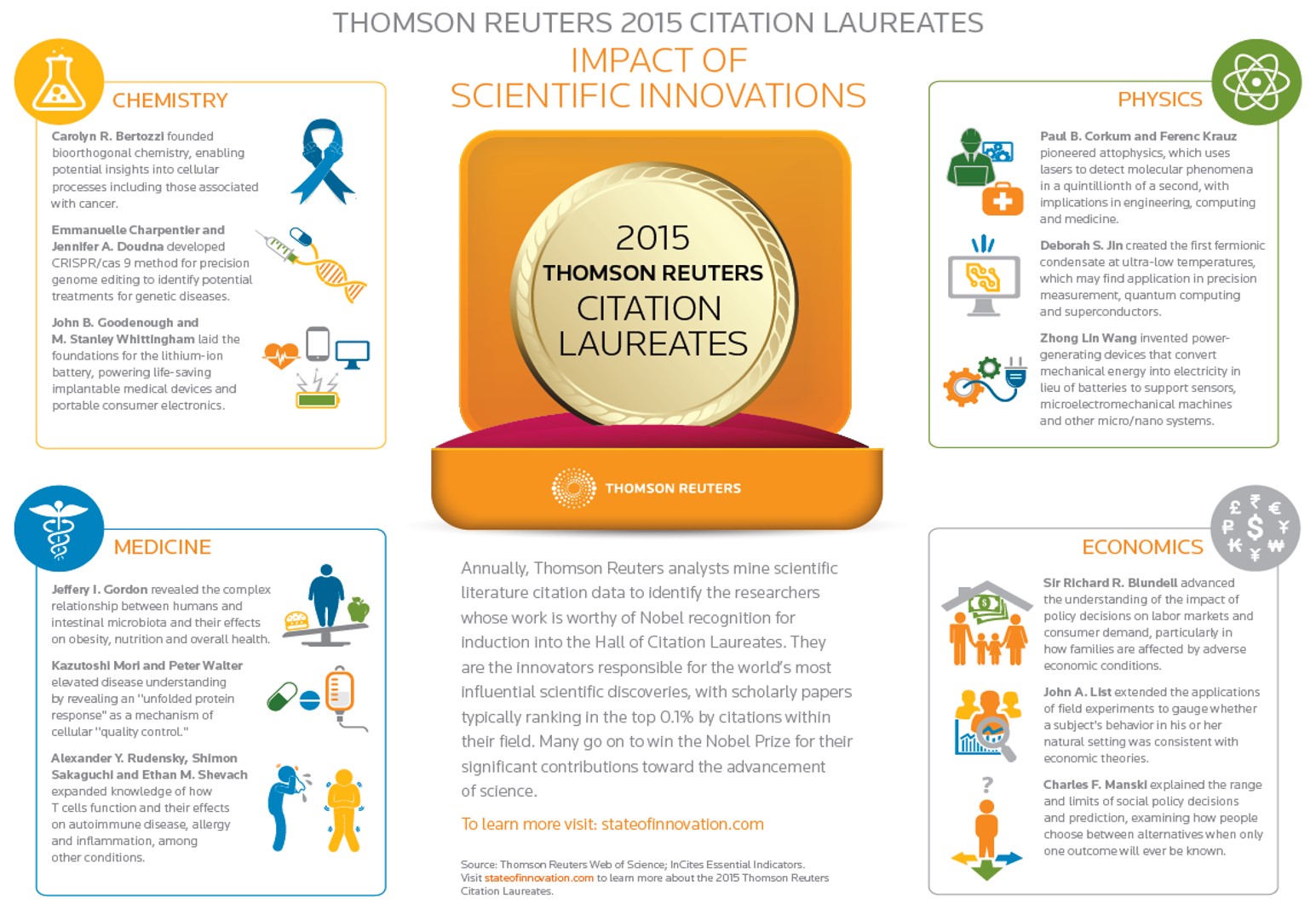
Over the next week, the recipients of the Nobel Prize will be announced one after the other. Would you like to impress your friends by forecasting the recipients? Here’s an infographic made by Thomson Reuters and detailing their forecasts for 2015. Good luck to everyone in it!

Listing of the top forecasts made by Thomson Reuters for each scientific Nobel Prize category in 2015. Originally from Thomson Reuters.
Listing of the top forecasts made by Thomson Reuters for each scientific Nobel Prize category in 2015.
Originally from Thomson Reuters.
Credit: the Nobel Prize medal's image at the top of the post was taken by Adam Baker on Flickr.

Sputnik Day: Could We have a New Space Race?

Exactly fifty-eight years ago, the Soviet Union rocked history with the successful launch of Sputnik 1 – the first time for humans to contribute a satellite to Planet Earth. While Sputnik was a pretty small satellite – only 58 cm in diameter – its launch triggered the Space Race, in which U.S.A and the Soviet Union tried to impress the world with their innovations, rockets and astronauts. The Space Race came to exciting culmination with the Moon landing on 1969, with a gradual decline ever since.

Today, we are swamped with 3,000 satellites orbiting the Earth. Without these satellites, our lives would not have been as easy as they are now. According to the Union of Concerned Scientists, satellites help us forecast the weather, enable us to navigate with GPS, send television signals straight to households, and many other things. In short, they’re incredibly useful, and it’s clear that we’re now reaping the investment made during the Space Race – even though at that time, the two superpowers mainly fought over the prestige of being the first, the best and the brightest.

So today, the day in which Sputnik 1 was launched, it’s interesting to me to think about a hypothetical scenario in which another technological breakthrough occurs: a real game-changer which forces all the world’s citizens to rethink their old beliefs, and drags all the superpowers into another race. What would that scenario look like?

First, it’s clear that the world is a fair bit more cynical today than it was during the Cold War. There are no longer two market and national philosophies at war today. Capitalism has clearly won the game, at least for now. While radical religion could be presented as a rival to democracy, the only place right now where the truly radical, unapologetic expressions of religion can be found are in the Islamic State. And while ISIS has proliferated in an unbelievably rapid pace, it lacks the capacity to make new scientific and technological discoveries. And let’s say gently that they’re not really impressing the world with their contributions to the humanities or the arts.

Since the world is largely uninterested in prestige anymore, we need a technological breakthrough whose impact and consequences would be clear from the outset. What breakthrough might that be?

Free Resources from Space

There are many answers to that question, like discovering a source of free energy (possibly cold nuclear fusion), or finding a way to play with the law of gravity and change the weight of buildings and even human beings (imagine that!). However, scientific breakthroughs are often made on the shoulders of giants – i.e. they rely on plenty of previous research and past successes – and the current scientific literature does not provide us any reassurance that anyone has even gotten close to figuring out these two challenges.

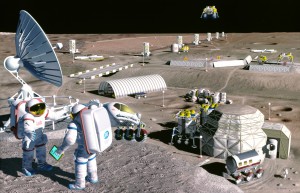
So let’s opt for a more likely scenario, and imagine that sometime in the next ten years, a private firm will succeed in mining an asteroid in deep space, and will bring back to orbit sacks full of gold and platinum. We could definitely imagine this scenario becoming reality, since there are currently at least two companies (Planetary Resources and Deep Space Industries) competing between themselves to be the first to mine asteroids and bring back their riches to Earth.

Were such a venture to succeed, it would have far-reaching consequences for the future of the Earth. At the moment, the developed world relies on many precious materials that can be found mostly in developing nations. According to data from Fast Company, these materials include fluorspar (CaF2, used for high-performance optics) from Mexico, cobalt and tantalum from the Democratic Republic of the Congo, niobium (Nb, used in microcapacitors and pacemakers) from Brazil, and an estimated $1 trillion in mineral deposits in Afghanistan. These countries would essentially lose a significant part of their income, if precious materials were to be imported from space.

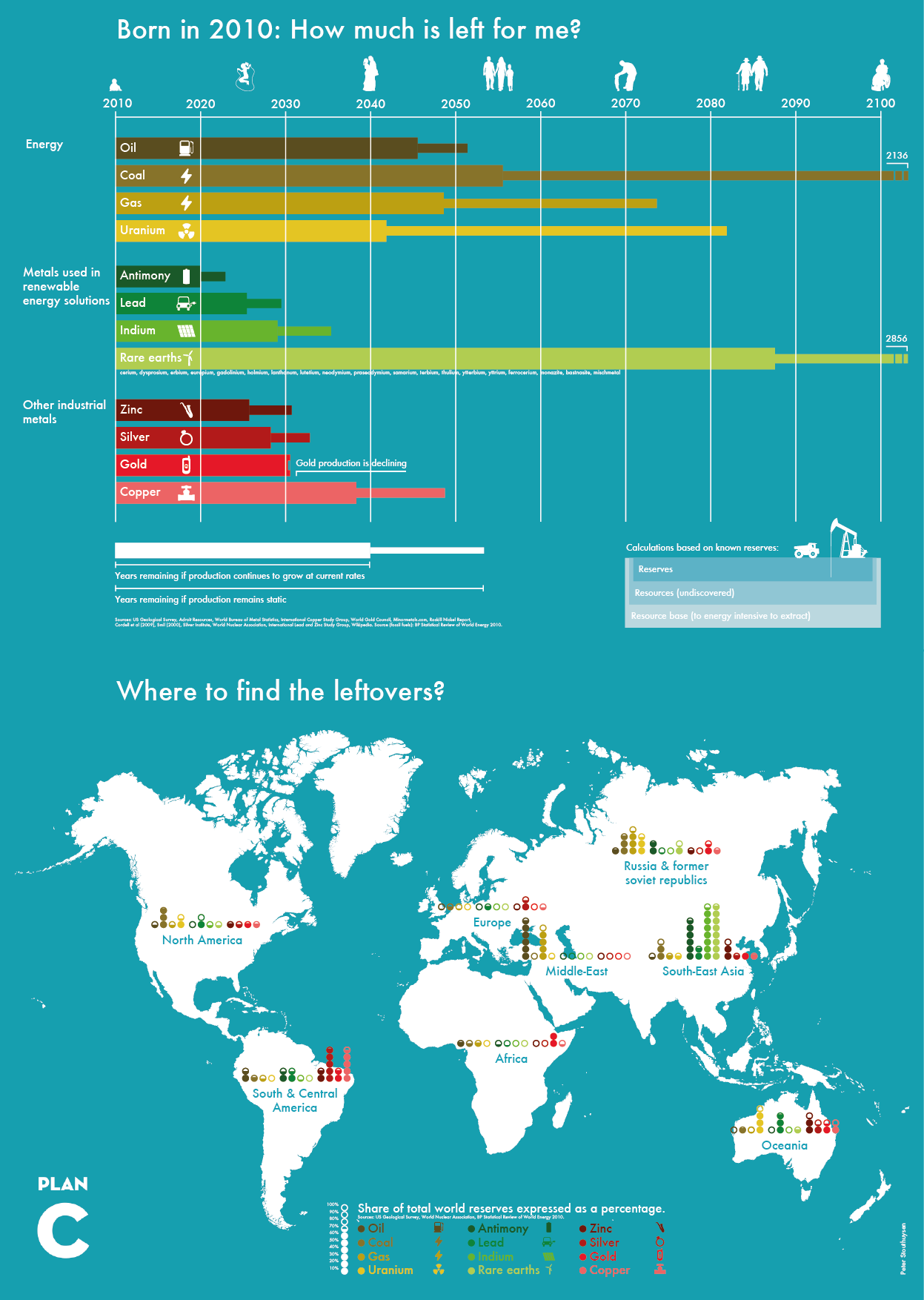
This chart by Visual Capitalist shows how long the resources on Earth will suffice. Please note the image here is about half of the full chart, which can be found in Venture Capitalist's site.
This chart by Visual Capitalist shows how long the resources on Earth will suffice.
Please note the image here is about half of the full chart, which can be found in Venture Capitalist’s site.

The developed and powerful nations would face other difficulties. Russia, the U.S.A., China, India, Japan and the European Union have all the means necessary to start space mining themselves, and they will strive to do so as soon as possible, so that each of them can be the first to get to the ‘easiest to pick’ asteroids – the ones whose trajectories bring them closest to Earth, and contain the largest concentrations of precious metals. At the same time, they will go into overdrive developing anti-spacecraft weapons, so that they can protect their investment in space. After all, nobody wants to drag an asteroid all the way to Earth, just to have a competing nation take control over it.

A space mining race, then, is one likely result of this scenario. An alternative, though, might be found in collaboration. Deep space has plenty of asteroids waiting for mankind to mine them, and 13,000 of those asteroids have orbits that bring them close to Earth. A single platinum-rich asteroid contains 174 times the yearly world output of platinum. Perhaps pooling together humanity’s resources, then, and coordinating every nation’s efforts, would be the best way to move forward and to share the abundant wealth to come.

Conclusion

I have no idea which way the world will turn to, but one thing is clear: this scenario forces everyone to rethink their positions regarding space, and to take action of one sort or the other. No nation would be able to afford itself to stay out of the new space race, or at least out of the debate for reallocation of resources that would come for it. There shall be much gnashing of teeth and a lot of anxiety on behalf of world leaders, but in the long term this development would prove to be one of the greatest boons even bestowed on humanity, leading to an era of abundance in precious metals and materials.

Interestingly, we are already starting to consider these scenarios seriously. In a recent workshop conducted by Dr. Deganit Paikowsky and yours truly, the full impact of a similar scenario was analyzed by students who role-played the different nations of the Earth. The results of the workshop will be publicized soon, but until they do, I would love receiving feedback from you: how do you think the nations would react to this scenario? Will we see a new space race, or a joint thrust forward? And which do you think will be the most efficient and successful way for humanity as a whole?

The answers to these questions could truly shape our future.

Gun Control for Mass-Shootings Soon to be Useless

Today, a 26 years old gunman opened fire at Oregon’s Umpqua Community College, killing at least ten people and injuring seven others. President Obama, a longtime opponent of the gun industry, immediately responded by issuing a fierce speech promoting gun regulation. While I do support a certain amount of gun regulation, it seems to me that Obama is still trying to lock the barn’s doors, long after the horses have escaped. Why am I saying that? Because even today, any person with a spare $1,000 in their bank account, would be able to print a gun for themselves.

You’ve probably heard before about 3D-printing. If you haven’t, you must’ve been hiding in a very deep cave with no WI-FI. The most simple and cheapest 3D-printers basically consist of a robotic arm that injects thin layers of plastic one on top of the other, according to a schematic that you can download from the internet. In that way, any user can print famous historical statues, spare parts for your dish washer, or a functional gun.

How easy is it to use a 3D-printer to print a gun? Much easier than it should be. When I was in Israel, I used a 3D-printer that cost approximately $1,500, in an effort to print a gun. I searched for the schematics that the Defense Distributed group devised and uploaded to the internet, and downloaded the files in less than two minutes from Pirate Bay. The printing itself took some time, and it took me some effort to stitch all the parts together, but in less than 48 hours I held in my hands a functional ghost gun of my own.

A 3D-printed gun. Credit goes to Kamenev.
A 3D-printed gun. Credit for this image and the upper one goes to Kamenev.

Why is it called a ghost gun? Because this gun is untraceable: it’s not registered anywhere, and it has no serial number. As far as the government knows, this gun does not even exist. And I could print as many guns as I wanted, with no one being the wiser. Heck, I could stockpile them in my house for emergencies, or give them out to militias and rebel groups.

The only problem is that the printed gun I downloaded is near useless. It has a recorded tendency to explode in your hands, and is not accurate at distances of more than two meters. Obviously, it is not a fully automatic or even a semiautomatic firearm. In short, I could just as well use a metal tube with gun powder at one end, and a stone stuck at the other. So yeah, it was a pretty lousy gun, back in 2013.

But now we’re getting near the end of 2015, and things have been changing rapidly.

Consider that the original schematics for the 3D-printed gun have been downloaded more than 100,000 times in just a few days after its release to the public. Since it is open source, everyone and anyone could make changes to the schematics, leading to a wide variety of daughter-schematics, that some of them are improved versions of the first clunky gun. Combine that with the elevated capabilities of today’s printers, and the many improvements that lie in store for us, and you’ll realize that in five years from now, gun control at sales venues will be largely useless, since people will be able to print sophisticated firearms in their households.

https://youtu.be/fI0FUHq3ItI?t=23s

Disarming the Future

Does that mean we should cut short any efforts for gun control in the present? Absolutely not. America is suffering from an epidemic of mass-shootings, partly because anyone can get himself or herself a deadly weapon with minimal background checks. At the same time, however, we should keep an eye out for technologies that disrupt the current gun industry, and which bring the power to manufacture firearms to the layperson.

How do we deal with such a future – which is probably a lot closer to becoming the present than most people suspect?

Here’s one answer for you: it turns out that the Oregon shooter has left a message on a social media forum this morning, warning some people not to come to school tomorrow. I’m not sure this message is the real deal, but we do know that people who commit mass-shootings leave behind evidence of their intentions in the virtual world.

Consider the following, just as anecdotes –

  • Eliot Rodger killed seven people in a mass-shooting in California. His Youtube videos pretty much state in advance what he was going to do.
  • Terence Tyler, an ex-marine who was suffering from depression, killed two of his co-workers and himself in a supermarket. Sometime before the incident he posted “Is it normal to want to kill your all your co-workers?” on Twitter twice.
  • Jared Loughner killed six people and wounded fourteen. Diagnosed as a paranoid schizophrenic, he wrote “Please don’t be mad at me” in Myspace, and took photos of himself with his trusty rifle in the morning of the shooting.

These are obviously just anecdotes, but they serve to highlight the point: everyone, even mass-killers, want to be noticed, to deliver their message to the public, or to share their intimate thoughts and anguish. Their musings, writings and interactions can all be found in the virtual world, where they are recorded for eternity – and can be analyzed in advance by sophisticated algorithms that can detect potential walking disasters.

While this sentence is rapidly becoming cliché, I must say it again: “This is NOT science fiction”. Facebook is already running algorithms over every chat, and is looking for certain dangerous phrases or keywords that could indicate a criminal intent. If it discovers potential criminals, Facebook alerts the authorities. Similarly, Google is scanning images sent via Gmail to identify pedophiles.

Obviously, identifying individuals that answer to the right (or very wrong) combination of declarations, status in life and other parameters could be a complicated task, but we’re starting at it today – and in the long run, it will prove to be more effective than any gun control regulation we can pass.

And so, here’s my forecast for the day: ten years from now, the president of the United States will stand in front of the camera, and explain that he needs the public’s support in order to pass laws that will enable governmental algorithms to go automatically and constantly over everyone’s information online – and identify the criminals in advance.

The alternative is that this future president won’t even ask for permission – and that should frighten us all so much more.

Gene-edited Micro-Pigs about to become Pets

Can you recognize where the following paragraph is from?

Hammond was flamboyant, a born showman, and… had an elephant that he carried around with him in a little cage. The elephant was nine inches high and a foot long, and perfectly formed, except his tusks were stunted. Hammond took the elephant with him to fund-raising meetings. Gennaro usually carried it into the room, the cage covered with a little blanket, like a tea cozy, and Hammond would give his usual speech about the prospects for developing what he called “consumer biologicals.” Then, at the dramatic moment, Hammond would whip away the blanket to reveal the elephant. And he would ask for money.


The story of Hammond and his miniature elephant (supposedly genetically engineered) appears in the opening pages of the book Jurassic Park. Ever since I read Jurassic Park in my teens, this is the paragraph that got stuck in my mind. After all, ravenous dinosaurs eating people is neat and everything, but having a tiny elephant living in your house, and showing it to your friends every time they drop by? Now that’s priceless – and definitely an idea I could relate to.

As it turns out, this dream is actually coming to fruition nowadays, with a Chinese prestigious institute announcing its intention to sell genetically engineered micro-pigs. Which, I guess, are a good substitute for a micro-elephant… at least for now.

The micro-pigs in question were engineered in a way that disabled their normal production of growth hormones, leading to the creation of a ‘dwarf’ pig. Their original purpose was to be used in medical studies of dwarfism and other metabolic disorders, since pigs are often used as models for human diseases. However, when they were revealed to the public at the Shenzhen International Biotech Leaders Summit in China one week ago, they stole the show.

“We had a bigger crowd than anyone,” said Lars Bolund, who took part in the pigengeering project, in an interview to Scientific American. “People were attached to them. Everyone wanted to hold them.”

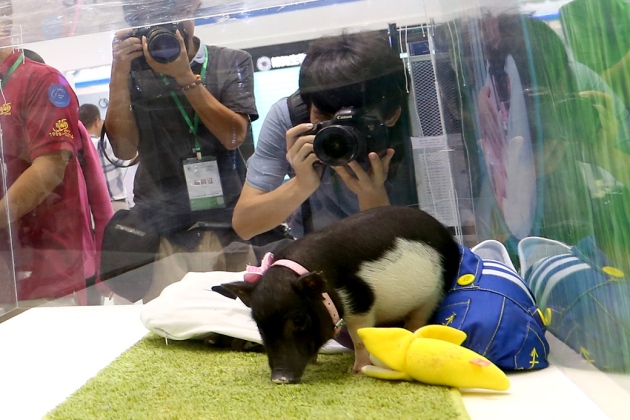
Micro-pigs caused an uproar in the Biomedical Summit in China. Image originally from Agricultural Biodiversity Weblog

The enthusiasm should not really have been surprising. There’s been a pig-pet craze for the past few decades, which scrupulous breeders have taken advantage of by selling “teacup pigs” – tiny piglets which were supposed to remain small through adulthood. As it turned out, many such piglets grew to weigh 100 – 150 pounds, forcing their owners to give the massive beasts up.

The micro-pigs should be relatively safe to purchase, and quite simply cannot reach a weigh of more than 15 kilograms, or more than the size of a medium-sized dog. That’s in their DNA – the genetic program that instructs their body on its final shape and size. The BGI Chinese institute is planning to sell them at $1,600 – and I won’t be surprised if the first batch will be snatched up within days by the rich and the famous who will be looking for new ways to demonstrate their… well, richness and fame.

But the really interesting question for me is: what will be the next genetically-engineered animal to make it to households as pet?

Dragon to Newt

The first (and possibly easiest to perform) kind of genetic engineering for household pets will be downsizing. As the BGI institute researchers have shown, you just need to disable the production of growth hormones in the animal to do that – a relatively easy task. Which animals will be downsized, then?

Endangered or threatened species will probably not be on the list, since the researchers need a mature female to give birth to the engineered baby-animal. Also, many large mammals have an extremely long pregnancies, which might make the venture unprofitable. So – I’m probably not going to enjoy my micro-elephant or micro-rhinoceros anytime soon.

If I had to bet on the animal of choice, my money would probably be on micro-crocodiles. The Nile crocodile is nowhere near endangered, and the female lays an average of fifty eggs, which hatch in three months. Baby crocodiles are already cute enough that some people will adopt them, with the obvious result of having to face a full-blown crocodile in the bathroom two years later. But what if they’re engineered to never grow any larger? I would probably chip in for a pet like that. A miniature horse or stag – if you just bring them down to the size of a house cat – wouldn’t hurt either.

Will micro-crocodiles be our next pets? Image of a baby crocodile taken from Pinterest - user Jessica Curzon
Will micro-crocodiles be our next pets?
Image of a baby crocodile taken from Pinterest – user Jessica Curzon

Glow in the Dark

“Glow in the dark animals” are already quite common in labs around the world. They’re being used for medical studies, but somehow have never found their way to the consumer market. The answer has a lot to do with the psychology of the consumer, but I would wager a guess that we just don’t like glow-in-the-dark cats or dogs. And why should we? The glow is mostly revealed only under UV light, and in any case – it would just make the animals frightening to behold.

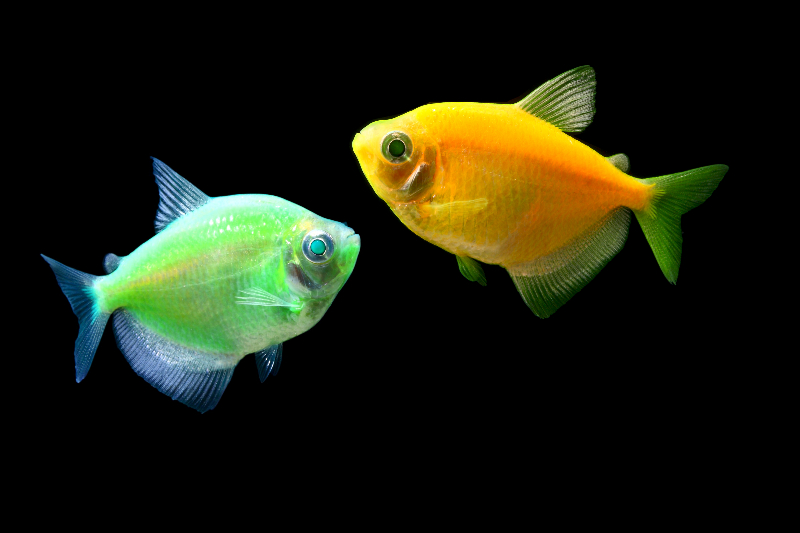
The only case in which glowing animals became a success was with aquarium fish (GloFish) that were the recipients of a jellyfish gene causing them to slow in the dark. Those fish are quite beautiful, but they grow only in the extremely secure and limited environment of the fish tank. Not really interesting, to be honest.

GloFish as our "glow in the dark" pets. Image originally from the GloFish site
GloFish as our “glow in the dark” pets. Image originally from the GloFish site

Cats Just Want to have Fun

Ragdoll cats are known as the most gentle and non-aggressive of all cats. They were bred specifically to be that way, and are a hit among adults and children who love the way cats look – but not the scars they leave on the skin.

Since we are beginning to identify genes that influence behavior and aggression in animals, why not use genetic engineering to bring some really ferocious animals to our houses?

I know that I wrote earlier against the engineering of endangered animals, but just consider: wouldn’t you like a full-sized tiger that is – quite literally – gentler than a kitten? Or how about a fun-loving shark in the swimming pool?

While these are probably extreme examples (you still have to feed these animals with tons of raw meat!), I think we can agree that smaller animals, like a people-loving raccoon, or a truly affectionate snake that likes to cuddle, could be a real hit.

Can We Stop GE-Pets?

By now you’re probably asking yourself if we can stop the technology from coming to fruition and delivering GE-pets to our doorsteps. It is extremely unlikely that the process will stop in any way, because of several reasons –

  • Globalization: if GE-pets are banned in one country, they’ll be engineered in another country like China. When their safety is demonstrated over time, they’ll spread around;
  • Powerful and cheap GE techniques: novel genetic engineering techniques are becoming rapidly cheaper and more powerful, which means that many private companies will soon start dabbling with synthetic biology. Even the venerable Bill Gates recently mentioned that if he were a kid today – he would be hacking biology. Governments will find it increasingly more difficult to stop these new companies from delivering their products to the market.
  • Eventual spread: let’s say you own a micro-pig, and your friend raises her own micro-pig. You like her, she likes you, and your micro-pigs like each other. What do you think will happen next? You could enjoy a litter of micro-pigs within less than a year, which you will give to your neighbors, whether they like them or not. Of course, most GE-pets will also be engineered to be sterile (companies have to protect their business investment, after all), but others will be fertile, and you can be sure that they’ll breed and spread throughout the land.

Conclusion

We are now at the beginning of a fascinating and exciting age: the age of synthetic biology, when animals could be molded according to our wishes. Obviously, we gain an enormous power over nature that way – but is it any different from raising animals in farms and stables? I’m not so sure. I also don’t see much of a danger to bio-diversity in the short-term, since the animals we will engineer for our needs will be hard-pressed to survive in nature (good luck to that micro-crocodile, or cuddling snake when they have to survive outside the house).

I’ll be waiting for my micro-crocodile to arrive sometime in this decade or the next.

And what would you kids like to get for Christmas?

Why School Bullying Is About to Disappear

Cody Pines is a hero, no doubt about it. When a high school bully physically assaulted his blind classmate last week, Pines was the only one of the surrounding people to actually leap forward and try to stop the fight. Admittedly his methods were somewhat harsh (he smashed the attacker to the ground with one punch), but it’s difficult not to cheer for him when watching the movie. It takes courage to act, when everybody else is just watching or making a Youtube movie.

That said, this incident is just a reminder of what’s going on in our school system. We usually don’t see what’s happening during the break, when all the pupils are playing outside the classroom. However, as I think anyone who’s ever been to a school can testify, there are plenty and plenty of fights, bullying, hair-pulling and other violent acts. And if you want to see the statistics, here are a few data points, straight from the CDC and the U.S. Department of Justice –

  • In 2011, an astounding number of 597,500 students aged 12 – 18 in the U.S. were victims of violence at school. In 2012, this number rose to 749,200
  • In 2011, 18% of students reported that there are gangs in their school.
  • In 2013, in a nationally representative survey of students in grades 9 – 12, more than eight percent reported that they were involved in a physical fight in school during last year. More than seven percent mentioned that they missed one day or more of school because they were afraid for their safety. And a whopping number of 19.6% reported being bullied in school.

Those numbers mean that students in school experience or witness fights almost constantly. That’s not surprising, of course: taking hormonally-charged teenagers, forcing them to interact with each other, and then making them stay together in the same class or school is a recipe for frustrations, anger and even violence. Basically, we’re expecting kids to play Survivor or Big Brother without resorting to violence, when even adults are known to lose their calm in such environments. What did you expect would happen?

In the headline of this article I claimed that school bullying is about to disappear, but now’s the time to admit that this forecast is only half-true. I sternly believe that physical bullying is about to go down radically in this decade and the next, while bullying of all the other sorts – such as virtual bullying and non-violent bullying in general will remain the same or even increase.

Here’s why: we’re going into a new world – the Monitored World.

The Monitored World

We are rapidly becoming surrounded by sensors. Nearly all of us, in fact, have at least five sensors in our pockets, in the shape of a smartphone. These sensors include a gyroscope, an accelerometer, a recorder, a GPS, and perhaps most importantly: a camera. Suddenly, we are all able to record whatever we see out there, and using Youtube we can share our findings with the entire world.

As of 2014, according to Pew Research Center, 64% of all American adults own a smartphone. While I have not been able to find similar statistics for youths, it seems likely that a large part of them own a smartphone as well, or will own a cheap (but functional!) one in the coming years, as prices keep going down.

In this sort of environment, any irregular activity will be immediately shared with the online audience, and will be judged accordingly. That is the public’s justice system: fully operated by the public, which is a judge, a jury and occasionally a hangman as well. Such a justice system, however, only takes note when the incident is truly extraordinarily cruel – as in the case of the blind child being beaten up. Only in such cases will the clip become viral, create a public uproar and force the authorities into action.

This is the state of things today. But how will sensors look like in five, ten or even fifteen years from now? They will be smaller, cheaper, and much more abundant. In fact, several large firms like Bosch, HP and Intel forecast that sometime between 2017 and 2022, we will have a trillion sensors in the world, which is about one hundred times the number of sensors we have today.

T Sensors forecast
The Trillion Sensors Vision. Image originally from Motherboard

What will those sensors look like? The short answer is that we won’t really notice them or think about them anymore, simply because they’ll be everywhere. They will be in our shoes and in our shirts. We’ll find them on our skins as electronic tattoos (of the kind that are being in development today) and on our eyes as the new versions of Google Glass. They’ll sit on our fingers as rings and measure our heart rate, our perspiration level and the activity we’re involved in right now. And where do you think all of the data being monitored by these devices will be sent to?

Let me answer this question with a short story about the future. Your son has just been physically bullied in school. His sensors immediately alerted you that he’s in pain and was involved in a fight, and you made a call to the school to let them know that. And as every angry dad should, you also let them know that if it happens again and they don’t break the fight early enough – you’re going to sue them for negligence. And if they do fight, you’ll know it immediately.

Now what do you think the school is going to do? Some schools will separate the two kids for good, which is hardly practical. Other schools will make the angry father understand that they can’t be responsible for everything that’s happening on their property – and then they should be willing to defend that position in court. And other schools – the ones in Silicon Valley, most probably – will take an altogether different approach and require the students to share their sensors data with the school system, to be monitored constantly by an artificial intelligence that will alert a teacher on the spot when young hearts start pumping too strongly.

These new school systems will monitor their students at all times. And why shouldn’t they? Most schools are treating the children as prisoners in any case: forced to sit for hours upon hours in one room, hearing content they don’t want to learn. When schools are required to safeguard the children from violence, do you really think they’ll care for their privacy?

Will all bullying disappear altogether? Obviously, it won’t. Some forms of bullying will become virtual, and happen in closed groups where the teachers won’t be able to discern it. Other forms of bullying – for example, when a group of popular kids excommunicate a certain student – will not be stopped so easily.

All the same, the Monitored World will largely bring an end to physical bullying… and along with it, will bring an end to kisses stolen in the dark, to young (and too young) lovers in the school’s basement, to the smoking of pot and many other unsanctioned acts. That is the meaning of the Monitored World: a world in which we must think carefully of the rules that we set to people and to students, because they will be enforced constantly.

Is that a good thing, or a bad one? The jury is still out on that, but at least we won’t have blind students being punched in the school halls.