I am a Futures Studies researcher with special expertise in foresight, wild cards (black swans), and analysis of emerging and disruptive technologies. I have spoken to hundreds of conference audiences and appeared frequently on TV and radio to discuss for a wide range of listeners and viewers the fascinating study of the future of technology and society. Most recently, I have been lecturing for and providing consultation to entities worldwide including large companies and firms, the Lahav Management School at Tel Aviv University and other educational institutions, and as an invited keynote lecturer to innovation and global thinking workshops internationally including Greece, Kazakhstan, and Belarus.
I was playing World of Warcraft – the famous Massive Multiplayer Online Role Playing Game (MMORPG) – last night, and became a member of a party of five players in order to complete a challenging dungeon. Normally, journeying together with four other people in a virtual world can be heaps of fun. The warriors hit monsters, the healers heal the warriors, and everybody is having fun together.
Well, not this time.
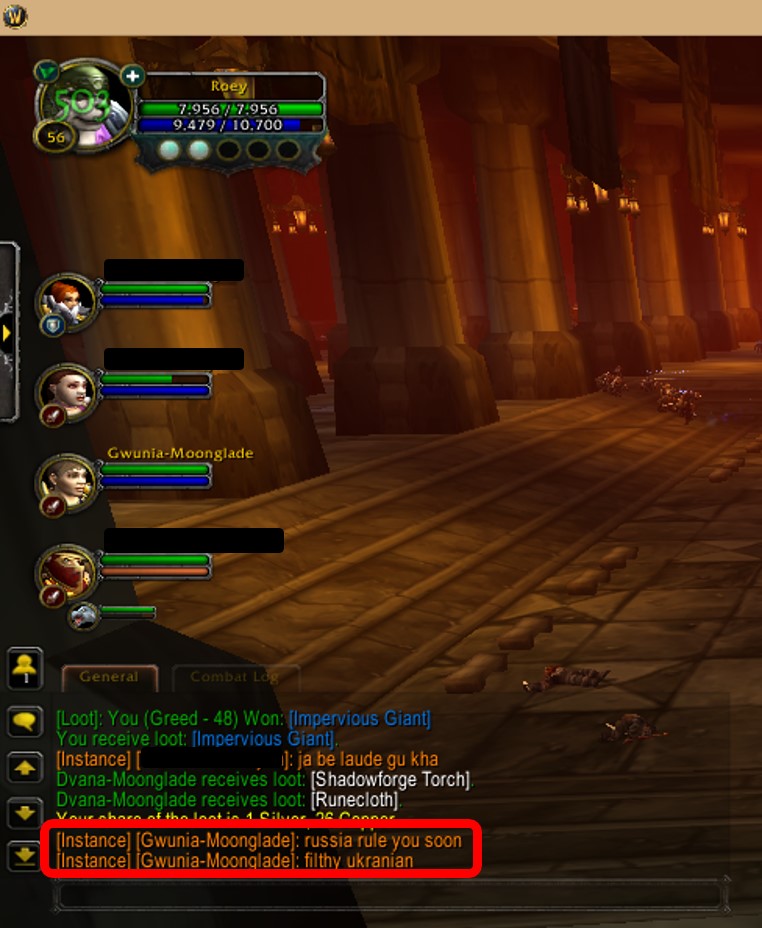
Halfway through the dungeon, one of the players began spouting some national slurs – “Russia rule you soon”, for one, and “Filthy Ukranian” among others. The response was pretty immediate – after a minute or two of shock, the offending player was kicked out of the party. We found another player in less than a minute and completed the dungeon at our leisure. The remarks, though, left an impression on me and made me think all through the evening about an interesting question: why don’t we see more breaches and break-ins from the physical world into the virtual one?
National slurring personally experiences in World of Warcaft
Virtual Worlds
Perhaps the term “virtual worlds” needs to be better defined. After all, Facebook too is a virtual world, and we see people bringing their problems and biases from the physical world into Facebook all the time. World of Warcraft, though, much like other MMORPGs, is a different virtual world. It’s a simulation, in fact, of a fantasy world filled with dragons, dungeons and real monsters who would like nothing more than to chew on your virtual bones.
This detachment from reality is probably the most important difference between MMORPGs and Facebook: on Facebook, you’re supposed to ‘play’ yourself and emphasize your views on the physical world. MMORPGs, however, are viewed more as vacation-time from reality. You go to MMORPGs to escape the conflicts of the physical world, not to accentuate them. This common understanding among players helps ensure that few incursions between the two worlds occur.
It is also my belief (and I don’t know any research to support it, since the field of MMORPGs has largely been ignore by political and social scientists) that MMORPGs bring into the equation something that we humans sorely lack in the modern ages: an evil enemy. Namely, I’m speaking of the computer that is controlling the world and the monsters in it. Those monsters will kill you if you don’t get strong enough. They are the ultimate evil – they can’t be reasoned with, and you can’t deliberate with them. It’s a kill or be killed environment, in which you have to become stronger constantly just to survive.
Compare this black and white environment to the one we experience in the physical world. In past times, tribal and national leaders tried to paint their enemies with a good vs. evil color palette. Namely: we’re the good guys, and they’re the bad guys. This kind of stereotyping doesn’t really work so well anymore, now that you can read everywhere about the woes and dilemmas of the other side, and realize that they’re humans just like you are. But realizing and accepting this fact requires conscious effort – it’s so much easier to hate, demonize and vilify the other side!
What wonder, then, that players are so happy leaving behind the grey national animosities of the physical world, and fight the good fight in the virtual worlds?
Meaning for the Future
These thoughts are pretty preliminary and shallow, and I post them here only because they are important for our future. In a decade or two from now we will enter a world in which the virtual and the physical aspects become mixed together constantly. As I wrote in an earlier post, wearable augmented reality devices are going to transform every street and every walking lane into a dungeon or a grassland field filled with monsters and treasure.
The virtual world is different from the physical one in many aspects, but one of the most important is that virtual wealth is infinite and priceless. One can find enormous treasures in the virtual world, beat his virtual computer-controlled opponents time after time, and in the future also enjoy virtual love (or at least sex) with virtual entities.
But what is the meaning of life in a virtual world? And since we’re about to experience a mixed-reality world soon, we must also consider: how do we keep on providing meaning and motivation to everyone in it?
It is possible that, based on the lessons of World and Warcraft and other MMORPGs, the programmers of the mixed-reality world will put an emphasis on the creation of true evil: of evil ghosts and dragons, and a perpetual fight for (virtual) survival against those. Maybe then, when we’re confronted by a greater enemy, we’ll be able to overlook our religious, national and racial biases and come together to fight the good fight in a game that will span nations and continents.
Does the future of mixed-reality holds dragons in store for us all, then? One can only hope.
Everywhere you go, you can find scientists and engineers doing 3-D printing. They may be using it to print bridges over water, or buildings and houses, or even hearts and livers and skull parts. In fact, we’re hearing so much about 3-D printers creating the normal and ordinary stuff all over again, that it’s becoming pretty boring.
This, of course, is how technology makes progress: slowly, and with iterative changes being added all the time. We’re currently using 3-D printers just to create all the old stuff, which we’re used to. The makers and creators are mainly interested today in demonstrating the capabilities of the printers, and put less emphasis on actually innovating and creating items that have never existed before, and of course, the clients and customers don’t want anything too extraordinary as well. That’s the reason we’re 3-D printing a prosthetic ear which looks just like a normal ear, instead of printing a Vulcan ear.
What happens if we let go of the ordinary and customary, and begin rethinking and reimagining the items and organs we currently have? That’s just what Manu S. Mannoor, Michael C. McAlpine and their groups did in Princeton and Johns Hopkins Universities. They made use of a 3-D printer to create a cartilage tissue the shape of a human hear, along with a conductive polymer with infused silver nano-particles. The end result? A bionic ear that should look and feel just like an ordinary ear, but has increased radio frequency reception. It is not far-fetched to say that Mannoor and McAlpine have printed the first biological ear that could also double as a radio receiver.
Mannoor, McAlpine and team’s 3D-printed bionic ear, with enhanced radio reception capabilities. Originally from paper “3D Printed Bionic Ears“
Where else may we see such a combination between the biological and the synthetic? This is a fascinating thought experiment, that could help us generate a few forecasts about the future. If I had to guess, I would venture a few combinations for the next twenty years –
Radio-conductive bones: have you come for a hip replacement, and also happen to have a pacemaker or some other implant? The researchers will supply you with a hip-bone printed specifically for you, which will also contain conductive elements that will aid radio waves go deeper into the body, so that the implants can receive energy more easily from the outside by radio waves or induction of some kind.
Drug delivering tattoos: this item is not 3-D printed, but it’s still an intriguing combination of a few different concepts. Tattoos are essentially the result of an injection of nano- and micro-particles under the skin. Why not use specific particles for added purposes? You can create beautiful tattoos of dragons and princesses and butterflies that can also deliver medicine and insulin to the bloodstream, or even deliver adrenaline when pressed or when experiencing a certain electrical field that makes the particles release their load. Now here’s a tattoo that army generals are going to wish their soldiers had!
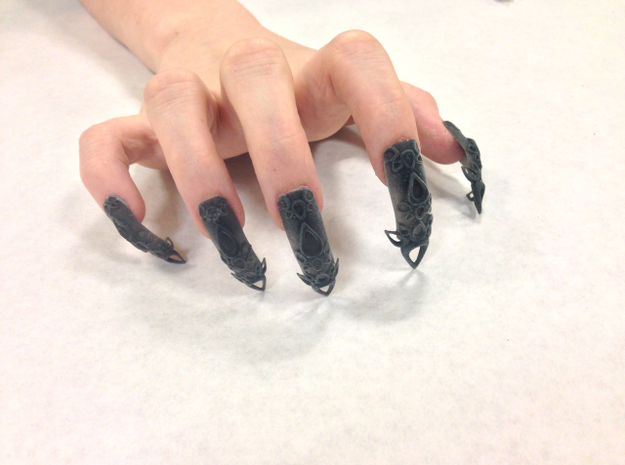
Exquisite fingernails: the most modern 3-D printers come with a camera and A.I. built-in, so that they can print straight on existing items that the user places in the printer. Why don’t we make a 3-D printer that can print directly on fingernails with certain kinds of materials? The fingernails of the future – which will be printed anew every day – might contain tiny batteries that will power smartphones by touch, or microphones that could record everything that happens around the user.
These are obviously just three rudimentary ideas, but they serve to show what we could gain by leaving behind the idea that new manufacturing technologies should adhere to the “old and proven”, and advance ahead to novel utilities.
In the end, the future is never just “same old same old”, but is all about shedding off the customs of the past and creating new ones. And so, if I had to guess, I would wager that such a unification of concepts into new and bizarre devices would give us a much more accurate view of the future than the one we gain in the present by showing how 3-D printers can build yet another house and another human organ.
What are your ideas for future combinations of biological and synthetic components? Write them down in the comments section!
Two weeks ago it was “Back to the Future Day”. More specifically, Doc and Marty McFly reached the future at exactly October 21st, 2015 in the second movie in the series. Me being a futurist, I was invited to several television and radio talk shows to discuss the shape of things to come, which is pretty ridiculous, considering that the future is always about to come, and we should talk about it every day, and not just in a day arbitrarily chosen by the scriptwriters of a popular movie.
All the same, I’ll admit I had an uplifting feeling. On October 21st, everybody was talking about the future. That made me realize something about science fiction: we really need it. Not just for the technological ideas that it gives us (like cellular phones and Tricorders from Star Trek), but also for the expanded view of the future that it provides us with.
Sci-fi movies and book take root in our culture, and establish a longing and an expectation to a well-defined future. In that way, sci-fi creations provide us with a valuable social tool: a radically prolonged Cycle-time, which is the length of time an individual in society tends to look forward to and plan for in advance.
Cycle-times in the Past
As human beings, and as living organisms in general, mother evolution has shaped us into fulfilling one main goal: transferring our genes to our descendants. We are, in a paraphrase of Richard Dawkins’ quote, trucks that carry the load of our genes into the future, as far as possible from our current starting point. It is curious realize that in order to preserve our genes into the future, we must be almost totally aware of the present. A prehistorical person who was not always on the alert for encroaching wolves, lions and tigers, would not have survived very long. Millions of years of evolution have designed living organisms so that they focus almost entirely on the present.
And so, for the first few tens of thousands years of human existence, we ran away from the tigers and chased after the deer, with a very short cycle-time, probably lasting less than a day.
It is difficult, if not impossible, to know when exactly we managed to strike a bargain with Grandfather Time. Such a bargain provided the early humans great power, and all they needed to do in return was to measure and document the passing of hours and days. I believe that we’ve started measuring time quite early in human history, since time measurement brought power, and power ensured survivability and the passing of genes and time measurement methodologies to the next generation.
The first cycle-time was probably quite short, lasting less than a full day. Early humans could roughly calculate how long it will take the sun to set according to its position in the sky, and so they could know when to start or end a hunt before darkness fell. Their cycle-time was a single day. The woman who wanted to know her upcoming menstruation period – which could lead to drawing predators and making it more difficult for her to hunt – could do that by looking at the moon, and by making a mark on a stick every night. Her cycle-time was a full month.
The great leap forward occurred in agricultural civilizations, which were based on an understanding of the cyclical nature of time: a farmer must know the cyclical order of the seasons of the year, and realize their significance for his field and crops. Without looking ahead a full year into the future, agricultural civilizations could not reach their full height. And so, ten thousand years ago, the first agricultural civilizations set a cycle-time of a whole year.
And that is pretty much the way it remained ever since that time.
One of the most ancient cycle-times, and the most common one as well: the seasons of the year.
Religious Cycle-times
Religions initially had the potential to provide longer cycle-times. The clergies have often documented history and made an attempt to forecast the future – usually by creating or establishing complex mythologies. Judaism has prolonged the agricultural cycle-time, for example, by setting a seven year cycle of tending one’s field: six years of growing corps, and a seventh year (Shmita, in Hebrew) in which the fields are allowed to rest.
“For six years you are to sow your fields and harvest the crops, but during the seventh year let the land lie unplowed and unused.” – Exodus, 23, 10-11.
Most of the religious promises for the future, however, were usually vague, useless or even harmful. In his book, The Clock of the Long Now, Stewart Brand repeats an old joke that caricaturizes with more than a shred of truth the difficulties of the Abrahamic religions (i.e. Judaism, Christianity and Islam) in dealing with the future and creating useful cycle-times in the minds of their followers. “Judaism,” writes Brand, “says [that] the Messiah is going to come, and that’s the end of history. Christianity says [that] the Messiah is going to come back, and that’s the end of history. Islam says [that] the Messiah came, and history is irrelevant.” [the quote has been slightly modified for brevity]
While this is obviously a joke, it reflects a deeper truth: that religions (and cultures) tend to focus on a single momentous future, and ignore anything else that comes along. Worse, the vision of the future they give us is largely unhelpful since its veracity cannot be verified, and nobody is willing to set an actual date for the coming of the Messiah. Thus, followers of the Abrahamic religions continue their journey into the future, with their eyes covered with opaque glasses that have only one tiny hole to let the light in – and that hole is in the shape of the Messiah.
Religious futile cycle-time: everybody is waiting for the Messiah, who will come sometime, at some place, somehow.
Why We Need Longer Cycle-times
When civilizations fail to consider the future in long cycle-times, they head towards inevitable failure and catastrophe. Jared Diamond illustrates this point time and time again in his masterpiece Collapse, in which he reviews several extinct civilizations, and the various ways in which they failed to adapt to their environment or plan ahead.
Diamond describes how the Easter Island folks did not think in cycle-times of trees and earth and soil, but instead thought in human shorter cycle-times. They greedily cut down too many of the trees in the island, and over several decades they squandered the island’s natural resources. Similarly, the settlers in Greenland could not think in a cycle-time long enough to contain the grasslands and the changing climate, and were forced to evacuate the island or freeze to death, after their goats and cattle damaged Greenland’s delicate ecology.
The agricultural civilizations, as I wrote earlier, tend to think by nature in cycle-times no longer than several years, and find it difficult to adjust their thinking into longer cycle-times: ones that apply to trees, earth and evolution of animal (and human) evolution. As a result, agricultural civilizations damage all of the above, disrupt their environment, and eventually disintegrate and collapse when their surroundings can’t support them anymore.
If we wish to keep humanity in existence overtime, we must switch to thinking in longer cycle-times that span decades and centuries. This is not to say that we should plan too far ahead – it’s always dangerous to forecast into the long-term – but we should constantly attempt to consider the consequences of our doings in the far-away future. We should always think of our children and grandchildren as we make steps that could determine their fate several decades away from now.
But how can we implement such long-term cycle-times into human culture?
If you still remember where I began this article, you probably realize the answer by now. In order to create cycle-times that last decades and centuries, we need to visit the future again and again in our imagination. We need to compare our achievements in the present to our expectations and visions of the future. This is, in effect, the end-result of science fiction movies and books: the best and most popular of them create new cycle-times that become entwined in human culture, and make us examine ourselves in the present, in the light of the future.
Movie Time
Science fiction movies and stories have an impressive capability to influence social consciousness. Karel Capek’s theater play R.U.R. from 1920, for example, had not only added the word “Robot” to the English lexicon, but has also infected western society with the fear that robots will take over mankind – just as they did in Capek’s play. Another influential movie, The Terminator, was released in 1984 and has solidified and consolidated that fear.
Science fictions does not have to make us fear the future, though. In Japanese culture, the cartoon robot Astro-Boy has become a national symbol in 1952, and ever since that time the Japanese are much more open and accepting towards robots.
Astro Boy: the science fiction series that made Japanese view robots much more warmly than the West.
The most influential science fiction creations are those that include dates, which in effect are forecasts for certain futures. These forecasts provide us with cycle-times that we can use to anchor our thinking whenever we contemplate the future. When the year 1984 has come, journalists all over the world tried to analyze society and see whether George Orwell’s dark and dystopian dream had actually come true. When October 21st 2015 was reached barely two weeks ago, I was interviewed almost all day long about the technological and societal forecasts made in Back to the Future. And when the year 2029 will finally come – the year in which Skynet is supposed to be controlling humanity according to The Terminator – I confidently forecast that numerous robotics experts will find themselves invited to talk shows and other media events.
As a result of the above science fiction creations, and many others, humanity is beginning to enjoy new and ambitious cycle-times: we look forward in our mind’s eye towards well-designated future dates, and examine whether our apocalyptic or utopian visions for them have actually come true. And what a journey into the future that is! The most humble cycle-times in science fiction span several decades ahead. The more grandiose ones leap forward to the year 2364 (Star Trek), 2800 (Dan Simmons’ Hyperion Cantos) or even to the end of the universe and back again (in Isaac Asimov’s short story The Last Question).
The longest cycle-times of science fiction – those dealing with thousands or even millions of years ahead – may not be particularly relevant for us. The shorter cycle-times of decades and centuries, however, receive immediate attention from society, and thus have an influence on the way we conduct ourselves in the present.
Conclusion
Humanity has great need of new cycle-times that will be far longer than any that were established in its history. While policy makers attempt to take into account forecasts that span decades ahead, the public is generally not exposed or influenced by such reports. Instead, the cycle-times of many citizens are calibrated according to popular science fiction creations.
Hopefully, those longer cycle-times would allow humanity to prepare in advance to existential longer-term challenges, such as ecological catastrophes or social collapse. At the very same time, longer cycle-times can also encourage and push forward innovation in certain areas, as entrepreneurs and innovators struggle to fulfill the prophecies that were made for certain technological developments in the future (just think of all the clunky hoverboards that were invented towards 2015 as proof).
In short, if you want to save the future, just write science fiction!
I loved her, on the spot. There was something in her stance, her walk, her voice. Hesitantly, I approached and opened a light chat. There was an immediate connection, a feeling of rapport between us. Finally, I dared pop the question – “Do you want to meet again tomorrow?”
She went quiet for a second, then asked to see my social credit rating. I tried to keep my face still while I took out my smartphone and showed it to her.
She went quiet for more than a few seconds…
This system – a social credit rating – is in the process of being created and implemented today in China. If it works out well, it’s going to have an impact that will spread far beyond the People’s Republic, and may become part of our lives everywhere. Because, you see, this system might actually be a good idea – as long as we use it wisely.
What is a social credit rating? In a way, it’s similar to the ordinary credit history rating being used in America and other countries. Every person in America, for example, has a credit history that speaks volumes about their past behavior, how soon they return their loans, and how they handle their money. When one applies for a new loan, a mortgage or even for a new credit card, the banks and financial institutes take a good hard look at the inquirer’s credit history to decide whether or not they can be safe giving him that loan.
Up until today, only 320 million individuals in China had any kind of credit history, out of 800 million people registered in China’s central bank. Things are about to change, though, since the Chinese government is authorizing several companies to collect and compare information about the citizens, thus creating an omnipotent, omniscient system that assigns a “social credit rating” to anyone who uses any kind of online services, including dating sites like Baihe, and commercial sites like Alibaba.
And the Chinese people are really gobbling it up.
While it’s obviously difficult to know how the common person in the street is responding, it looks like the Chinese companies (again, under close scrutiny and agreement by the government) really know how to sell the idea to their customers. In fact, they’re letting the customers ‘sell’ the idea themselves to their friends, by turning the social credit rating into a game. People are comparing their ratings to each other, and are showing their ratings on their smartphones and their profiles on dating services. For them, it has become a game.
But it is a game with very serious consequences.
Her face fell when she saw my rating. I talked quickly – “I-It’s not what it looks like. You gotta understand, I didn’t have the money to repay Big Joe last week, but now I’m getting all the wages I was owed. Seriously, it’s OK. I’m OK financially. I really am.”
There’s no denying that credit history ratings can serve a positive purpose. They alert individuals and companies to the past history of con artists, scammers and generally unscrupulous people whom you’d rather not have any dealings with. The mere presence of a credit history rating could cause people to trust each other better, and also to behave themselves in their financial dealings. People from market societies tend to deal more fairly with strangers because they know their actions are always counted for or against them. A credit history rating essentially makes sure that everyone knows they are monitored for best behavior – and that’s a powerful force that can help maintain civil order.
It is also a powerful tool in the hands of a government that wants to control its citizens.
She bit her bottom lip, and her brow furrowed. She kept my smartphone in her hand, scrolling down quickly and reading all the fine details. Suddenly she raised her head and stared at me.
“You played Assassin’s Creed for one hundred hours last month?” she demanded to know. I nodded dumbly, and watched as the smile spread slowly on her lips. “I love that game! I play it all the time myself!”
I felt butterflies swimming across my vision. She was obviously The One for me. Such a perfect fit could never happen by chance. And yet, I felt I needed to check one last thing.
“Can I see your social rating too?” I asked timidly, and waited an eternity for her answer.
It’s pretty easy to understand how one’s credit history rating in America is determined. You just need to pay your bills in time in order to maintain a good credit history. A social credit rating, however, is a different thing altogether. At least one of the companies in charge of calculating it, does not agree to expose how the rating is determined, except that the calculation is based on “complex algorithm”. Which essentially means that nobody knows exactly how they’re being judged and rated – except for the big companies and the government.
Does that make you feel like the Chinese are entering into an Orwelian totalitarian rule? It should. There are persistent rumors that the Chinese social credit will be determined according to the users’ online activities in social media. When the Chinese government is in total control, who do you think will get a better social rating: the citizens who support the government unconditionally, or the dissidents who oppose the government’s doings?
In short, a social rating could be a great way for any government to control the population and the opinions and points of view it advocates and stands for. And since the social rating could be a dynamic and constantly changing parameter, it could change rapidly according to every new action a person takes, every sentence and cussword they utter. The government only has to set the rating algorithms – and the automated monitoring and rating systems will do the rest.
I walked back and forth in my small room, silently cursing myself for my foolishness. So what if her social rating was so low? She must have been a supporter of the opposition for it to drop by so much, but what of it? I’m not a political activist anyway. Why should I care?
And yet, I had to admit to myself that I cared. How could I go out with someone with that kind of a low rating? All my friends will know. They’ll laugh at me behind my back. Worse still, my own social rating would go down immediately. I will not only be the laughing stock of my class in the University – I would not even be legible anymore for a scholarship, and all my dreams for a higher degree would end right there and then.
I sighed, and sat back on the squeaky bed. She just wasn’t right for me, in this time in life. Maybe when I have a better social rating, to balance her own. Maybe the algorithms would change their decision about her someday.
But that would probably be too late for us.
The social rating system is currently voluntary, but within five years China is planning to rank everyone within its borders. It’s going to be interesting to see how it’s working out for the Chinese. And who knows? Maybe we’ll get to have a taste of the system as well, probably sooner than later. Whether that’s a good or bad thing, is still up to grabs.
A few days ago I wrote a post about the WHO’s declaration that processed meat can cause cancer in human beings. Since posts from this blog also appear on my Facebook page, and many people comment there, I noticed a curious phenomenon: the knee-jerk response of many commenters was to cast doubt on the results of the committee who reached these decisions. Some of the doubters hinted that the committee members had ulterior motives. Others contended that the studies the committee relied upon to reach a decision, could not distinguish between meat eating and many other lifestyle choices that could heighten the risk of cancer.
Many indeed were those who doubted the results, for many wide-ranging reasons. And yet, from reading the comments it’s quite clear that none of them knows who exactly are the committee members, or which 800 papers they relied upon to make a decision. The main objective of the comments was to disparage the results that stand in contrast with the commenters’ current way of life.
Now, I’ll say straight ahead that the transparency of the evaluation process is definitely at fault. I haven’t yet had any success in finding the names of the experts on the committee, nor details about the “800 different studies on cancer in humans” they examined, or how much weight each study carried for them. In a world of information and transparency, it seems almost ridiculous that a body such as the WHO does not provide easy access to these details to the public, so that independent researchers and thinkers can make their own evaluations.
All the same, the first wave of doubters that we face now are probably a sign for the near future of the meat arena. In fact, if we learn anything from the way other industry giants have dealt with uncomfortable scientific evidence in the past, it’s that the spreaders of doubt will soon become prevalent in social media and on radio and TV.
Doubt, Tobacco and Climate Change
In the middle of the 20th century, the tobacco industry found itself facing a difficult challenge. An increasingly large number of scientific studies revealed a connection between smoking and cancer. The tobacco companies turned to one of the leading PR firms of the day, Hill & Knowlton, which reframed the situation: the dilemma was not whether or not smoking causes cancer, but what the public thinks on the matter. A key memo emphasizes the real issue from their point of view –
“There is only one problem—confidence and how to establish it; public assurance, and how to create it.”
In other words, the tobacco industry realized that it needed to create doubt about the scientific evidence. To that end, the industry founded ‘independent’ organizations that ‘studied’ the subject and reached conclusions that had almost no relation with the scientific reality or consensus. The industry also supported and promoted scientists who were willing to talk on behalf of tobacco and to publish studies (shaky as they were) against the connection between smoking and cancer.
I’ll admit this accusation would’ve seemed much like a conspiracy theory, if not for the fact that the internal communications in the tobacco companies was eventually made public. The industry could not challenge the scientific evidence for more than a few decades. Eventually, at the end of the 1990s, forty six states filed a collective lawsuit against the four largest tobacco companies. The companies agreed to pay a large fine, to shut down their funded ‘independent’ research organizations like the Center for Indoor Air Research, and to make all the related documents available to the public. This is how we know today how the history of tobacco in America really looks like: a grim mix of propaganda and greed, which was spilled on the public by the big companies. Overall, the tobacco industry had worked actively to plant and promote disinformation which has significantly damaged the public’s capabilities to act in a legal and enlightened way against smoking. Since a billion people are smoking today worldwide, and as the life expectancy of smokers is ten years shorter than that of their friends, it can be said that the tobacco companies have cost humanity ten billions years of living.
That is a pretty hefty fee to pay.
We see the same strategy of doubt casting being used today by ExxonMobil to counter scientific evidence for global warming and climate change, with some of the scientists who spoke against the relation between tobacco and cancer also speaking against the relation between human activity and climate change.
And quite soon, we’ll probably see it in use by the meat industry as well.
Meat and Doubt
Already, the meat industry starts casting doubt on the committee’s conclusions. Shalene McNeill, director of Human Nutrition Research at the National Cattlemen’s Beef Association, had this to say on the WHO’s declaration –
“These are studies that draw correlation, not causation. So these are studies that cannot be used to determine cause and effect.”
Her point is well-known to all scientists who review these studies, so I can’t imagine any of them falling for this old trick in interpretation.
another statements made by the meat industry about the WHO’s ruling included “Dramatic and alarmist overreach”, which seems strange in light of the fact that similar conclusions about the connection between meat and cancer have already been reached by the American Cancer Society and the World Cancer Research Fund. So nothing dramatic or overreaching here. If anything, the WHO is just falling into the ranks of the current scientific understanding of the issue.
Nathan Gray, science editor in the popular FoodNavigator site, has reported that he has received a large number of responses from trade associations and PR agencies representing the meat industry last week. Most of these responses, according to Gray, claim that the committee’s findings are biased, and that “the science is undecided or misrepresented”.
In short, they’re all casting doubt. We’ve seen this strategy being used before. We’re seeing it again right now.
Conclusion and Forecast
You want a final forecast, don’t you? Well, here’s an easy one: unless some kind of a miracle happens, we’re going to see a lot of doubt mongering coming from the meat industry in the next few years. Get ready for it. It’s coming, and it’s also going to rely a lot on social media. Social media is the new communications arena, where anyone can level baseless accusations, spread rumors and thrive on attention. If ever there was a place almost designed for disinformation, this is it.
Get ready. The doubt industry is marshalling its forces once more.
Two days ago, the International Agency for Research on Cancer, part of the World Health Organization (WHO) released a statement that’s probably still causing the meat industry leaders to quiver in their star-studded boots. The agency has convened together a working group of 22 experts, who reviewed more than 800 studies on the association between cancer and red and processed meat. The final results were phrased unequivocally: eating just 50 grams of processed meat every day makes one 18% more likely to develop colorectal (bowel) cancer.
The obvious question that rises now deals with the future of meat eating. Are we about to see the demise of hamburger joints? Is McDonald’s about to go down in flames, along with its beef patties?
Probably not, at least in the short term, for a few reasons.
Reasons for Meat to Stay
I divide the reasons that meat will remain in culture into two different categories, each coming from a different audience: the reactions in the public, and the innovations coming from start-ups.
The Public
Will the public forego meat? That is one possible outcome, but it seems extremely radical in the short term. Even now, articles in journals and magazines bring sense and nuances into the WHO’s declaration: they explain that while an 18% increased chance to develop cancer sounds frightening, the actual numbers are much more nuanced. When Cancer Research UK crunched the numbers, it found out that –
“…out of every 1000 people in the UK, about 61 will develop bowel cancer at some point in their lives. Those who eat the lowest amount of processed meat are likely to have a lower lifetime risk than the rest of the population (about 56 cases per 1000 low meat-eaters).”
Now, that sounds much less scary, doesn’t it?
The articles also explain the rationale behind the WHO’s five categories of potential cancer-inducing agents and chemicals. In Group 1 you can find the agents that the experts are certain of their potential to cause cancer, but there is no distinction between the different levels of harm caused by each substance! That means that tobacco and processed meat exist side by side in Group 1, even though smoking kills more than one million people every year, whereas processed meat kills ‘only’ 34,000 people every year. And guess what? People are still smoking, with 17.8% of all U.S. adults smoking cigarettes!
And that leads us to another matter: people are willing to do things that are harmful to them in the long run. We go out to the sun, even though the sun’s radiation is also in the Group 1. Women take contraceptives to make sure they do not get pregnant – despite the known increased risk of cancer. And of course, 51.9% of all Americans aged 12 or older consume alcohol, even though the ethanol in the drink has also been shown to cause cancer. So you’ll pardon me if I don’t stop investing in meat production anytime soon (figuratively, since I don’t invest in the stock market; I’m a wary futurist).
All of the above does not mean that we won’t let go of meat eventually, in the long term. But at least in the short term, much more needs to happen in order to make people radically change their dietary habits. Culture, as you may remember from a previous post about pace-layer analysis, is very slow indeed to change.
The New Meat Start-Ups
Whenever human beings run into a wall that stands in the way of their desires, they either break it down or find ways to go around it. The most obvious solution in this case would be to develop new kinds of cooking and preservation methods for meat that do not involve the dangerous chemicals highlighted by the WHO. We can expect to see hamburger joints coming up with hamburgers made from unprocessed meat, possibly with an emphasis on freshness. And since it seems that barbecuing the meat can also cause cancer, other types of dishes like goulash might gain popularity in place of steaks.
While I don’t know what innovations will come up in the meat industry, I feel confident that they will arrive. Where there is great need, there is also great money – and innovators go where the money is.
Conclusion
Even in the face of the WHO’s declaration, there doesn’t seem to be much of a chance that people will stop eating meat anytime soon. Note the emphasis on “soon”. It is entirely possible that a movement will rise out of this declaration, and urge people to let go of meat altogether. Such a movement will probably base itself on panic-mongering, distorting the evidence to lead people to the belief that all meat is bad for them. But even this kind of a movement will take time to develop and gather political and social power, which means the meat industry probably still has at least one generation’s lifetime – twenty years – to survive. Whether you like this assessment or not depends on your previous beliefs.
I would like to draw attention to one last issue at steak (pardon the pun). The WHO’s committee reported that – “The most influential evidence came from large prospective cohort studies conducted over the past 20 years.” This innocent comment reveals once again the importance of conducting research and collecting data long into the future. Most research today only lasts as long as it takes the student obtain his or her graduate degree, which makes it very difficult to collect data over time.
This is a topic for another post, really, so for now I’ll just end by saying that there is a very real need to support and fund lengthier research. Research that lasts decades provides the best evidence about the impact of nutrition and lifestyle over our lives, and it should be encouraged in the scientific community.
Last week, Yam Mesicka from Israel ordered a cover photo for his web site from a Fiverr seller. He requested that the gig be done in 24 hours, asked for the PSD file, and added a few other extras for a final bill of $80. Yam then sat back and relaxed, knowing that in 24 hours he will receive what he has paid for.
Twenty four hours later, he was still waiting. Agitated and under time pressure, he considered cancelling his order, but found out he could only do that after 48 hours had passed. So he waited some more, and on the 47th hour, he received the finished product, which was extremely shoddy and amateurish in his view.
Yam told the seller he wanted a refund. The seller did not consent. Yam turned to Fiverr for help, and after four days was told that he should ask the seller to cancel the deal. He explained to the representative that he tried to reason with the seller to no avail, at which point she patiently encouraged him to continue negotiating.
That was the point when Yam broke down and realized the salvation was not going to come from Fiverr’s management. Instead, he turned to the PayPal account from which he was supposed to pay the bill, and opened a dispute with Fiverr, explaining that they did not give him the return for his money. A short time later, he received a mail from Fiverr telling him that his Fiverr account was now blocked, and asking him to cancel the dispute. In other words, Fiverr was essentially trying to force Yam’s hand in a dispute he had against a single seller, which Fiverr’s representative allegedly refused to solve herself.
Yam’s story is still developing, and Fiverr has not replied to my request that they comment on it. But there is at least one lesson we can learn from it, about the future of justice systems in the world and how citizens turn from governmental justice systems – i.e. courts – to commercial ones owned and operated by big companies.
Justice Systems
In modern society, the government is the main source of justice, with appointed judges supplying justice to all who come before them. The only problem is that the system isn’t really working for most cases of civil disputes. The justice system has turned into a complex monstrosity of rules, laws, rulings and lawyers who can navigate the system for exorbitant fees. Rebecca Lova Kourlis, a former justice of the Colorado Supreme Court, describes the situation best in her own words in The Atlantic –
“…let’s say your teenage daughter gets into a car crash with an uninsured motorist. She is badly injured and has to have shoulder surgery that eliminates her ability to get that tennis scholarship to college — and now you must pay for the car, the medical bills, and college. You need to sue the uninsured driver. It’s likely, however, that the costs of the litigation will exceed your losses — and even more likely that it will take years to resolve the case. Too often today, the last place to go for actual justice is civil court.”
The problem is doubly obvious in Yam’s case, and generally for every commercial company that sells its services to millions of customers at the same time, like Amazon, eBay, Fiverr and others. The courts simply cannot provide an answer to the millions of citizens who want to get a relatively small refund, or some other compensation for unsatisfactory services. And so, the large companies have opened dispute resolution centers of their own, and those are taking care of millions of disputes every year.
But what happens when a customer is unhappy with a certain dispute’s resolution?
This, in essence, is Yam’s case. Being unsatisfied with the way the dispute was being handled by Fiverr, he turned to PayPal’s dispute resolution system. In other words, he tried to switch from one commercial justice system to a competing one.
Is it really so surprising that Fiverr refused to acknowledge the authority of PayPal’s dispute resolution system? Of course not. Let’s be honest: companies want to keep their customers’ disputes to themselves, and it’s perfectly understandable why Fiverr won’t accept PayPal’s dispute resolution process. All the same, since PayPal controls the money transfer, Yam may even get his money back from Fiverr.
And all throughout this story, the governmental justice system is nowhere to be found.
This is a sign of the things to come. As I mentioned before, the current governmental justice system is quite simply incapable of taking care of most of citizens’ civil disputes. In its place come the commercial justice systems, whose rules are not necessarily dictated by governments, morals or ethics. In fact, there is nearly no real supervision by governments on commercial justice systems.
You may side with the seller in Yam’s story, or with Fiverr, or even with Yam himself. The side you choose to take are beside the point. The real story here is that the execution of justice is rapidly being relegated to commercial companies, each of which with its own unsupervised justice system. And some of which – like Fiverr – are apparently willing to ban you from their services if you turn to justice systems other than its own.
Does that scare you yet? If not, just consider what happens if Google decides to ban you from using your Gmail mailbox just because you opened a dispute with it. A relatively small number of incredibly large companies are controlling our virtual platforms. They are gaining power rapidly while the government loses power, and people like Yam are caught in between. And there’s no dispute about that.
A few days ago I decided that I wanted a new business card for the up and coming new year. I headed straight to Fiverr, and browsed through some of the graphic designers who offered their services for five dollars or more. After a few minutes, my choice was made: I decided to use the designer with more than a hundred of 5-star positive ratings, and literally no negative reviews at all.
Of course, the gig didn’t really cost five dollars. I added $10 to receive the source file as well, $5 for the design of a double-sided business card, and $5 for a “more professional work”, as the designer put it. Along with other bits, the gig cost $30 altogether, which is still a good price to pay for a well-designed card.
Then the troubles began.
I received the design in 24 hours. It was, simply put, nowhere near what I expected. The fonts were all wrong, the colors were messed up, and worst of all – the key graphical element in front of the card was not centralized properly, which indicates to me a lack of attention to details that is outright unprofessional. So I asked for a modification, which was implemented within a day. It was not much better than the original. At which point I thanked the designer, and concluded the gig with a review of her work. I gave her a rating of generally three stars – possibly more than I felt that her skills warrant, and wrote a review applauding her effort to fix things, but also mentioned that I was not satisfied with the final result.
An hour later, the designer sent me a special plea. She asked me, practically in virtual tears, to remove my review, telling me that we can cancel the order and go to our separate ways. She told me that her livelihood depends on Fiverr, and without high ratings, she would not be approached by other buyers in the future.
A discussion I had with a Fiverr service provider, who begged me to give her a higher rating
I knew that my money would not actually be returned to me, since Fiverr only deposits the return in your Fiverr account for the next gigs you will purchase from them.But seeing a maiden so distraught, and me having an admittedly soft heart, I decided to play the gallant knight and deleted my negative review.
And so, I betrayed the community, and added to the myth of Fiverr.
Lessons for the No-Managers Workplace
In December 2011, the management guru Gary Hamel published an intriguing piece in the Harvard Business Review called “First, Let’s Fire All the Managers”. In the article, Hamel described a wildly successful company – The Morning Star Company – based on a model that makes managers unnecessary. The workers regulate themselves, criticize each other’s work, and deliberate together on the course of action their department should take. Simply put, everyone is a manager in Morning Star, and no one is.
You should read the article if this interests you (and it should), but just to sum up – Morning Star has some 400 workers, so it’s not a small start-up, and the model it’s using could definitely be scaled-up for much larger companies. However, Hamel included a few admonishments, the first of which was the need for accountability: the employees in Morning Star must “deliver a strong message to colleagues who don’t meet expectations,” wrote Hamel. Otherwise, “self-management can become a conspiracy of mediocrity.”
The employees in Morning Star receive special training to make sure they understand how important it is that they provide criticism and feedback to other employees, and that they actually hurt all the other employees if such feedback is not provided and made public. Apparently the training works, since Morning Star has been steadily growing over the past few decades, while leaving its competitors far behind. In fact, today “Morning Star is the world’s largest tomato processor, handling between 25% and 30% of the tomatoes processed each year in the United States.”
Morning Star is a shining example for a no-managers workplace which actually works in a competitive market, since each person in the firm makes sure that others are doing their jobs properly.
But what happens in Fiverr?
Is Fiverr Broken?
I have no idea how many service providers on Fiverr beg their customers for high ratings. I have a feeling that it happens much more frequently than it should, and that soft-hearted customers like me (and probably you too) can become at least somewhat swayed by such passionate requests. The result is that some service providers on Fiverr will enjoy a much higher rating than they deserve – which will in effect deceive all their future potential customers.
Fiverr could easily take care of this issue, by banning such requests for high rating, and setting an algorithm that screens all the messages between the client and the service provider to identify such requests. But why should Fiverr do that? Fiverr profits from having the seemingly best designers on the web, with an average of a five stars rating! Moreover, even in cases where the customer is extremely ticked off, all that will happen is that the service provider won’t get paid. Fiverr keeps the actual money, and only provides recompensation by virtual currency that stays in the Fiverr system. This is a system, in short, in which nobody is happy, except for Fiverr: the customer loses money and time, and the service provider loses money occasionally and gets no incentive or real feedback that will make him or her improve in the long run.
Conclusion
As I wrote earlier, Fiverr could easily handle this issue. Since they do not, I rather suspect they like the way things work right now. However, I believe that sooner or later they will find out that they have garnered themselves a bad reputation, which will keep future customers away from their site. We know that great start-ups that have received a large amount of funding and hype, like Quirky, have toppled before because of inherent problems in their structures. I hope Fiverr would not fail in a similar fashion, simply because it doesn’t bother to winnow the bad apples from its orchard.
When Achariya, an ordinary woman from Cambodia got pregnant, she was scared out of her wits. Pregnancy can become a death sentence for women in developing countries, with every year more than half a million mothers dying during pregnancy or child birth. In Cambodia specifically, “maternity-related complications are one of the leading causes of death among women ages 15 to 49”, according to the Population Reference Bureau. Out of every 100,000 women delivering a baby, 265 Cambodian mothers do not make it out of the birth room alive. In comparison, in developed countries like Italy, Australia and Israel, only 4–6 mothers out of 100,000 perish during childbirth.
While there are many different reasons for the abundance in maternal mortality, a prominent one is chronic conditions like anemia caused by iron deficiency in food. Dietary iron deficiency affects about 60% of pregnant Cambodian women, and results in premature labor, and hemorrhages during childbirth.
There is good evidence that iron can leech out of cast-iron cookware, such tools can be too expensive for the average Cambodian family. But in 2008 Christopher Charles, a student from the University of Guelph had a great idea: he and his team distributed iron discs to women in a Cambodian village, asking them to add it to the pot when making soup or boiling water for rice. The iron was supposed to leech from the ingot and into the food in theory. In practice, the women took the iron nuggets, and immediately used them as doorstops, which did not prove as beneficial to their health.
Charles did not let that failure deter him. He realized he needed to find a way to make the women use the iron ingot, and after a conversation with the village elders a solution was found. He recast the iron in the form of a smiling fish – a good luck charm in Cambodian culture. The newly-shaped fish enjoyed newfound success as women in the village began putting it in their dishes, and anemia rate in the village decreased by 43% within 12 months. Today, Charles and his company are upscaling operations, and during 2014 alone have supplied more than 11,000 iron fish to families in Cambodia.
The Lucky Iron Fish in a gift package. Source: Wikipedia, by Dflock
Pace Layer Thinking
For me, the main lesson from the iron fish experiment is that new technology cannot be measured and analyzed without considering the way in which society and current culture will accept it. While this principle sounds obvious, many entrepreneurs overlook it, and find themselves struggling against societal forces out of their control, instead of adapting their inventions so that they be easily accepted by society.
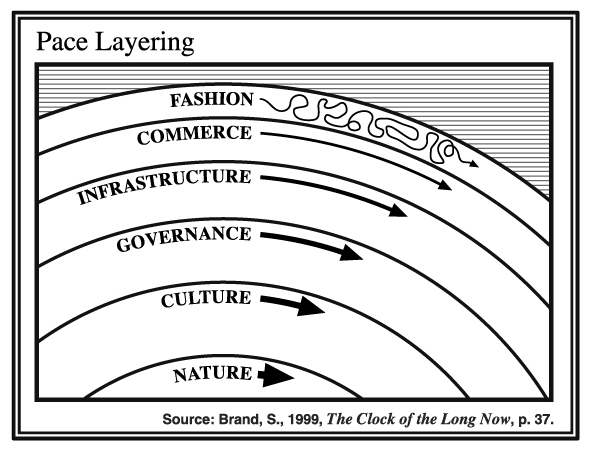
We have here, in essence, a very clear demonstration of the Pace Layering model developed and published by Stewart Brand back in 1999. Brand distinguishes between six different layers which describe society, each of which develops and changes at a pace of its own. Those layers are, in order from the ones that change most rapidly, to the ones that are nearly immovable:
The upper layers are moving forward more rapidly than the lower ones. They are the Uber and Airbnb (commerce layer) that stand in conflict with the Government’s regulations (governance layer). They are the ear extenders (fashion layer) that stand in conflict with the unwritten prohibition to significantly alter one’s body in Western civilization (culture layer). And sometimes they are even revolutionary governmental models used to control the population, as did the communist regimes in USSR which conflict with the very biological nature of the human beings put in control over such countries (governance layer vs. nature layer).
As you can see in the following slide (originally from Brand’s lecture at The Interval), the upper layers are not only the faster ones, but they are discontinuous – meaning that they evolve rapidly and jump forward all the time. Unsurprisingly, these layers are where innovations and revolutions occur, and as a result – they get all the attention.
The lower layers are the continuous ones. Consider culture, for example. It is impressively (and frustratingly) difficult to bring changes into a cultural item like religion. It takes decades – and sometimes thousands of years – to make lasting changes in religion. Once such changes occur, however, they can remain present for similar vast periods of time. And some would say that religion and Culture are blindingly fast when compared to the Nature layer, which is almost impossible to change in the lifetime of the individual.
You can easily argue that the Pace Layer Model is flawed, or missing some parts. Evolutionary psychologists, for example, believe that our psychology is a result of our genetics – and thus would probably put some aspects of Culture, Commerce, Governance and even Fashion at the Nature level. Synthetic biologists would say that today we can play with Nature as we wish, and as a result the Nature level should be jumpstarted to an upper level. It could even be said that companies like Uber (Commerce level) are turning out to have more power than governments (Governance level). Regardless, the model provides us with a good standing point to start with, when we try to think of the present and the future.
What does the Pace Layer Model have to do with the smiling luck fish? Everything and nothing. While I don’t know whether Charles has known of the model, a similar solution could’ve been reached by considering the problem in a Pace Layer thinking style. Charles’ problem, in essence, revolved around creating a new Fashion. He had a hard time doing that without resorting to a lower level – the Culture level – and reshaping his idea in ways that would fit the existing culture.
Pace Thinking about the Israel-Palestine Conflict
We can use Pace Layer thinking to consider other problems and challenges in modern times. It’s particularly interesting for me to analyze about the Israel-Palestine ongoing conflict, from a layer-based point of view.
There is currently a wave of terrorist attacks in Israel, enacted by both Palestinians and Israeli-Arabs from East Jerusalem. I would put this present outbreak at the Fashion level: it’s happening rapidly, it’s contagious (more terrorists are making attempts every day), and it’s drawing all of our attention to it. In short, it’s a crisis which we should ignore when trying to get a better long-term view of the overall problem.
What are the other layers we could work with, in regards to the conflict? There is the Commerce layer, representing the trade happening between Israel and the Palestinian Authority. If we want to lessen the frequency of crises like the current one, we should probably find ways to increase trade between the two parties. We could also consider the Infrastructure and Governance layers, thinking about shared cities, buildings or other infrastructures.
Last but not least – and probably most importantly – we need to consider the Culture layer. There is no denying that some aspects of the conflict revolve around the religions and other cultural habituations of each side. When a young Israeli-Arab gets up from bed in the morning, feels repressed and decides to murder a Jewish citizen, we need to ask ourselves why the culture around him hadn’t encouraged him to turn to other means of expressing his anger, like writing a column in the paper, or getting into politics. So the culture must change – and we need to find ways to bring forth such a change.
Obviously, these preliminary ideas and thoughts are merely starting points for a deeper analysis of the problem, but they serve to highlight the fact that every problem and every conflict can be analyzed in several different layers, none of which should be ignored, and that the best solutions should take into consideration several different layers.
Conclusion
The Pace Layer model of thinking can be a powerful tool in the analysis of every challenge, and could be used in many different cases. We’ll probably use it in the future in other articles on this blog, to analyze different situations and crises and examine the deeper layers that exist under the most fashionable and rapid ones.
In the meantime, I dare you to use the Pace Layer model to consider problems of your own – whether they’re of the national kind or entrepreneurial in nature – and report in the comments section what you’ve found out.
Picture from Wikipedia, uploaded by the user Yerevanci
Today I would like to talk (write?) about the first of several different failures in foresight. This first failure – called the Failure of Nerve – had been identified in 1962 by noted futurist and science fiction titan Sir Arthur C. Clarke. While Clarke has mostly pinpointed this failure as a preface for his book about the future, I’ve identified several forces leading to the Failure of Nerve, and discuss ways to circumvent it, in the hope that the astute reader will avoid making similar failures when thinking about the future.
Failure of Nerve
The Failure of Nerve is one of the most frequent of failures when talking or writing about the future, at least in my personal experience. When experts or even laypeople are expressing an opinion about the future, you expect them to be knowledgeable enough to be aware of the facts and the data from the present. And yet, all too often, this expectation is smashed on the hard-rock of mankind’s arrogance. The Failure of Nerve occurs when people are too fearful of looking for answers in the data that surrounds them, and instead focus on repeating their preconceived notions – which might’ve been true in the past, but are no longer relevant in the present.
Examples for Failures of Nerve are sadly abundant. Many quote Simon Newcomb, the famous American astronomer, who declared that flying machines are essentially impossible, a mere two years before the first flight of the Wright brothers –
“The demonstration that no possible combination of known substances, known forms of machinery and known forms of force, can be united in a practical machine by which man shall fly long distances through the air, seems to the writer as complete as it is possible for the demonstration of any physical fact to be.”
However, this is not a Failure of Nerve, since in Newcomb’s time, the data from the scientific labs themselves was incorrect. As the Wright brothers wrote about their experiments –
“Having set out with absolute faith in the existing scientific data, we were driven to doubt one thing after another, till finally, after two years of experiment, we cast it all aside, and decided to rely entirely upon our own investigations.”
Newcomb’s Failure of Nerve appeared later on, when he was confronted with reports about the Wright brothers’ success. Instead of withholding judgement and checking the data again, Newcomb only conceded that flying machines may have a slight chance of existing, but they could certainly not carry any other human beings other than the pilot.
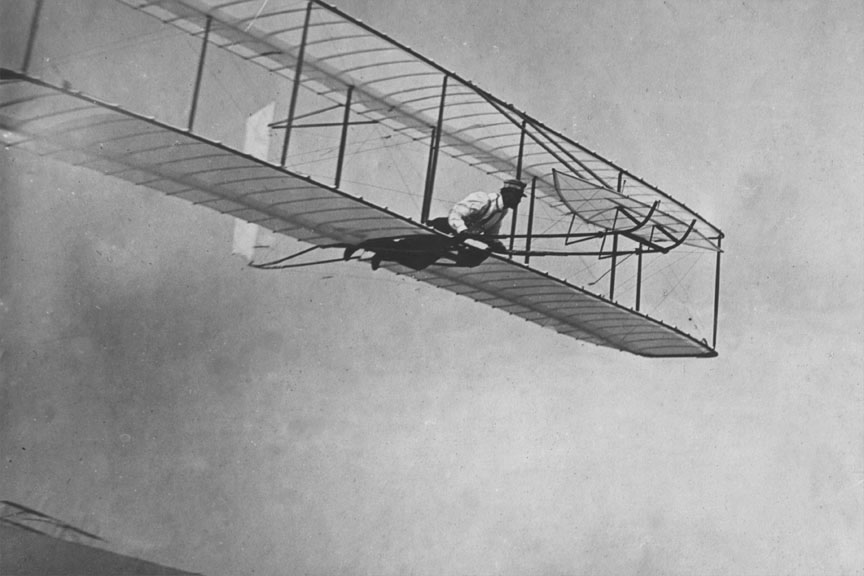
The first flight of the wright brothers – against the better judgement of the scientific experts of the time. Source: Wikipedia
A similar Failure of Nerve can be found in the words of Napoleon Bonaparte from the year 1800, uttered in reply to news regarding Robert Fulton’s steamboat –
“What, sir, would you make a ship sail against the wind and currents by lighting a bonfire under her deck? I pray you, excuse me, I have not the time to listen to such nonsense.”
Had the uprising emperor bothered to take a better look at the current state of steamboats, he would’ve learned that boats with “bonfires under their decks” were already carrying passengers in the United States, even though the venture was not a commercial success. Fulton went on to construct a steamboat (nicknamed “Fulton’s Folly”) that rose to fame, and in 1816 France finally recovered its senses and purchased a steamboat from Great Britain. Knowing of Napoleon’s genius in warfare, it is an interesting thought exercise to consider how history might have changed had the emperor realized the potential in steamboats when the technology was still emergent.
Is it possible that steamboats like this one would’ve changed the course of history, had Napoleon not been affected by the Failure of Nerve? Source: Wikipedia
How do we deal with a Failure of Nerve? To find the answer to that question, we need to understand the forces that make this failure so common.
Behind the Curtains of the Nerve
There are at least three different forces that can contribute to a Failure of Nerve. These are: selective exposure to information, confirmation bias, and last but definitely not least – the conservation of reputation.
The Force of Selective Exposure
Selective exposure to information is something we all suffer from. In this day and age, we have an abundance of information. In the past, news would’ve had taken weeks and months to get to us, and we only had the village elder’s opinion to interpret them for us. Today we’re flooded by information from multiple media sources, each of which with its own not-so-secret agenda. We’re also exposed to columns by social critics and other luminaries, and we can usually tell in advance how they look at things. If you read Tom Friedman’s column, you can be sure he’ll give you the leftist approach. If you open the TV at The Glenn Beck Program, on the other hand, you’ll get the right-winged view.
An abundance of information is all good and well, until you realize that human beings today suffer from a scarcity in attention. They can only focus on one article at a time, and as a result they must choose how to divide their time between competing pieces of information. The easiest choice? Obviously, to go with the news that support your current view on life. And that is indeed the way that many people choose – and understandably results in a Failure of Nerve. How can you be aware of any new information that stands in contradiction to your core beliefs, if you only listen to the people who repeat those same core beliefs?
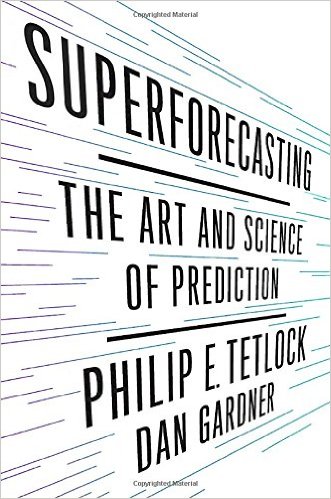
Philip E. Tetlock, in his new book Superforcasting, tells about Doug Lorch, one of the top forecasters discovered in recent years, who has found a way to circumvent selective exposure, albeit at an effort. In the words of Tetlock (p. 126) –
“Doug knows that when people read for pleasure they naturally gravitate to the like-minded. So he created a database containing hundreds of information sources – from the New York Times to obscure blogs – that are tagged by their ideological orientation, subject matter, and geographical origin, then wrote a program that selects what he should read next using criteria that emphasize diversity. … Doug is not merely open-minded. He is actively open-minded.”
Of course, reading opposite views to the one you adhere to can be annoying and vexing, to say the least. And yet, there is no other way to form a more nuanced and solid view of the future.
Superforecasting: The Art and Science of Prediction. By Philip E. Tetlock and Dan Gardner
The Force of Confirmation Bias
Sadly, even when a person chooses to actively open his or her mind to different views, it does not mean that they will be able to assimilate the lessons into their outlook. As human beings, one is wired to –
“…search for, interpret, prefer, and recall information in a way that confirms one’s beliefs or hypotheses while giving disproportionately less attention to information that contradicts it.” – Wikipedia
The confirmation bias is well-known to any expecting future-parent. You walk around in the city, and you find that the street is choke-full of parents with strollers and babies. They are everywhere. You can’t avoid them in the streets, on the bus, and even at work you find that your co-worker had decided to bring her children to the workplace today. So what happened? Has the world’s birth rate doubled itself all of a sudden?
The obvious answer is that we are constantly influenced by confirmation bias. If our mind is constantly thinking about babies, then we’ll pay more attention to any dripping toddler crossing the road, and the memory will be etched much more firmly into our minds.
The confirmation bias does not influence only young parents. It has some real importance in the way we view our world. A study from 2009 demonstrated that when people were asked to read certain articles spend 36 percent more time, on average, reading articles that they agreed with. Another study from 2009 demonstrated that when conservatives are watching The Colbert Report – in which Stephen Colbert satirizes the part of a right-winged news reporter – they read extra-meaning into his words. They claimed that Colbert only pretends to be joking, and actually means what he says on the show.
How does confirmation bias relate to the Failure of Nerve? In a way, it serves to negate some of the bad reputation that the Failure of Nerve has garnered from Clarke. The confirmation bias basically means that unless we make a truly tremendous and conscious attempt to analyze the world around us, our mind will fool us. We’ll pay less attention to evidence that refutes our current outlook, and consider it of lesser importance than other pieces of evidence. Or as the pioneer of the scientific method, Francis Bacon, put it (I found this great quote in a highly recommended blog: You Are Not So Smart) –
“The human understanding when it has once adopted an opinion (either as being the received opinion or as being agreeable to itself) draws all things else to support and agree with it.”
Can we fight off the influence of the confirmation bias over our thinking process? We can do that partially, but never completely and it will never be easy. Warren Buffett (third on the list of Forbes’ richest people in the world, and one of the most successful investors in the world) uses two means to tackle the confirmation bias: he specifically looks for dissenters and invites them to speak up, and (assumedly) he’s writing down promptly any piece of evidence that stands in contradiction to his current ideas. In the words of Buffet himself (quoted in TheDataPoint) –
“Charles Darwin used to say that whenever he ran into something that contradicted a conclusion he cherished, he was obliged to write the new finding down within 30 minutes. Otherwise his mind would work to reject the discordant information, much as the body rejects transplants.”
In short, in order to minimize the impact of confirmation bias, you need to remain constantly vigilant against the tendency to be certain of yourself. You must chase after those who disagree with you and seek their opinions actively, and perhaps most importantly: you should write it all down in order to distance yourself from your original perspective, and allow yourself to judge your thinking as though it were someone else’.
The Conservation of Reputation
One of the best known laws in the physical world is the Conservation of Mass. Only slightly less well-known is the law of Conservation of Reputation, which states that the average expert always takes the best of care not to lose face or reputation in his or her dealings with the media. Upton Sinclair had summed up the this law nicely when he wrote –
“It is difficult to get a man to understand something, when his salary depends on his not understanding it.”
Sadly enough, most experts believe that revisions of past forecasts, or indeed any change of opinion at all, will diminish and tarnish their reputation. And so, we can meet experts who will deny reality even when they meet it face-to-face. Some of them are probably blinded by their own big ideas and egos. Others probably choose to conserve what’s left of their reputation and dignity at any cost, even as they see their forecasts shrivel and wither in the light of the present.
The story of Larry Kudlow is particularly prominent in this regard. Kudlow forecast that President George W. Bush’s substantial tax cuts will result in an economic boom. The forecast fell flat, and the economy did not progress as well as it did during President Clinton’s reign. Kudlow did not seem to notice, and declared that the “Bush Rush” is here already. In fact, in 2008 he proclaimed that the current progress of American economy “may be the greatest story never told”. Five months later, Lehman Brothers filed for bankruptcy, and the entire global financial system collapsed along with that of the U.S.
I am going to assume that Kudlow was truly sincere in his proclamations, but obviously many other experts will not feel the need to be as honest, and will adhere to their past proclamations and declarations come hell or high water. And if we’re totally honest, then it must be said that the public encourages such behavior. In January 2009, The Kudlow Report (starring none other than Kudlow himself) began airing on CNBS. Indeed, sticking to your guns even in the face of reality seems to be one of the most important lessons for experts who wish to come up with the upper hand in the present – and assume correctly that few if any would force them to come to terms with their forecasts from the past.
Conclusion
In this text, the first of several, I’ve covered the Failure of Nerve in foresight and forecasting. The Failure of Nerve was originally identified by Arthur C. Clarke, but I’ve tried to make use of our current understanding of behavioral psychology to add more depth and to identify ways for people to overcome this all-too-common failure. Another book which has been very helpful in this endeavor was the recently published Superforecasting by Philip E. Tetlock and Dan Gardner, which you should definitely read if you’re interested in the art and science of forecasting.
There are obviously several other failures in foresight, which I will cover in future articles on the subject.



















 Curating the Future